
Euphorbia heterophylla
- noun
- Specialized
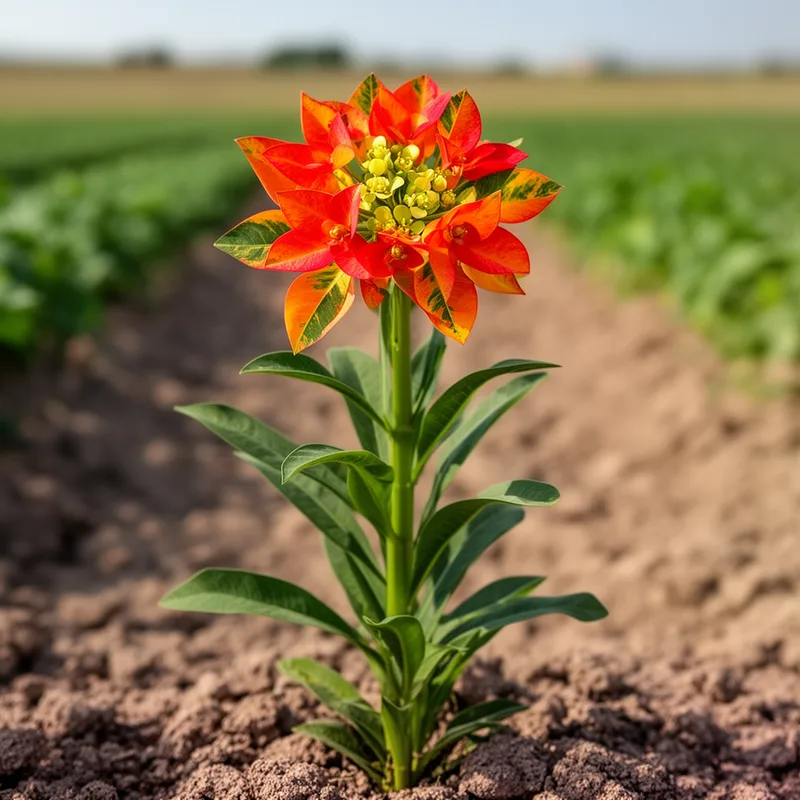
- Euphorbia heterophylla, also known as the showy poinsettia, flourishes in fields and gardens across the southern United States.
Examples
-
Gardeners appreciate Euphorbia heterophylla for its bright, attractive bracts.
-
The leaves of Euphorbia heterophylla can vary significantly in shape even on the same plant.
-
Euphorbia heterophylla is commonly found in agricultural fields throughout Florida.
-
The Euphorbia heterophylla is often used in ornamental gardens.
-
Did you know that Euphorbia heterophylla can thrive in warm climates?
-
Gardeners often choose Euphorbia heterophylla for its eye-catching red and green bracts that brighten up any landscape.
-
In tropical regions, Euphorbia heterophylla is valued for its ability to adapt to various soil conditions and climates.
Synonyms

A showy plant from warm places with bright red leaf-like parts

A plant with bright red leaves often used for holiday decoration
Surface Forms
Morphology
Euphorbia + heterophylla
This is a scientific binomial (genus + specific epithet): a learner who knows 'Euphorbia' (a plant genus) can reasonably infer this refers to a species of that genus. However, 'heterophylla' is a Latin epithet not listed in the learner dictionary and its descriptive meaning ('different leaves') is not predictable to a B1 learner, so the overall meaning is only partially transparent.
Etymology
Euphorbia heterophylla mixes a personal name and a simple Greek description. The part Euphorbia may come from a Greek doctor called Euphorbus who used similar plants as medicine. The part hetero- plus phylla means 'different' and 'leaves', and because this plant often has leaves of different shapes, the name tells you it has 'different leaves'.

