
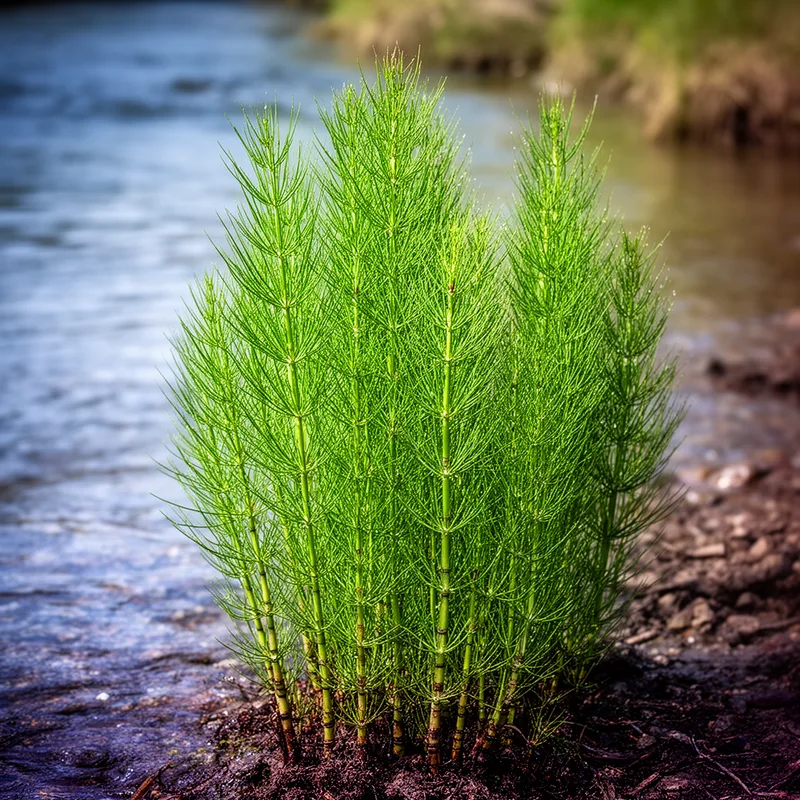
Equisetum arvense
- noun
- Specialized
- The feathery stems of Equisetum arvense sway gently in the breeze, adding a unique texture to the landscape.
Examples
-
You can often spot Equisetum arvense growing along riverbanks in spring and early summer.
-
The dried Equisetum arvense is sometimes used in herbal remedies for its diuretic properties.
-
Due to its rapid spread, Equisetum arvense can quickly become a nuisance in gardens.
-
The Equisetum arvense is often found in wetland areas.
-
Many gardeners appreciate the beauty of Equisetum arvense.
-
Gardeners often struggle to control the growth of Equisetum arvense as it can spread rapidly and dominate flower beds.
-
In wet conditions, Equisetum arvense thrives, often creating dense patches that are easily recognizable.
Synonyms

A common plant with thin hollow stems and bushy branches that grows in damp fields

A common plant with jointed stems like reeds that grows near water
Surface Forms
Morphology
Equisetum + arvense
This is a Latin binomial (genus + specific epithet) used as a scientific name; knowing 'Equisetum' might tell a learner it is a horsetail plant, but the epithet 'arvense' is a Latin morpheme not listed here and does not convey a clear English meaning to a B1 learner. Understanding the full referent (the particular species) requires taxonomic/Latin knowledge or prior exposure, so the overall expression is not derivable from ordinary English vocabulary knowledge.
Etymology
Equisetum arvense comes from old Latin words. Equisetum joins equi ('horse') and setum ('bristle') because the stiff, brush-like stems look like a horse's tail, and arvense means 'of the field', so the name pictures a brushy plant that grows in fields.

