
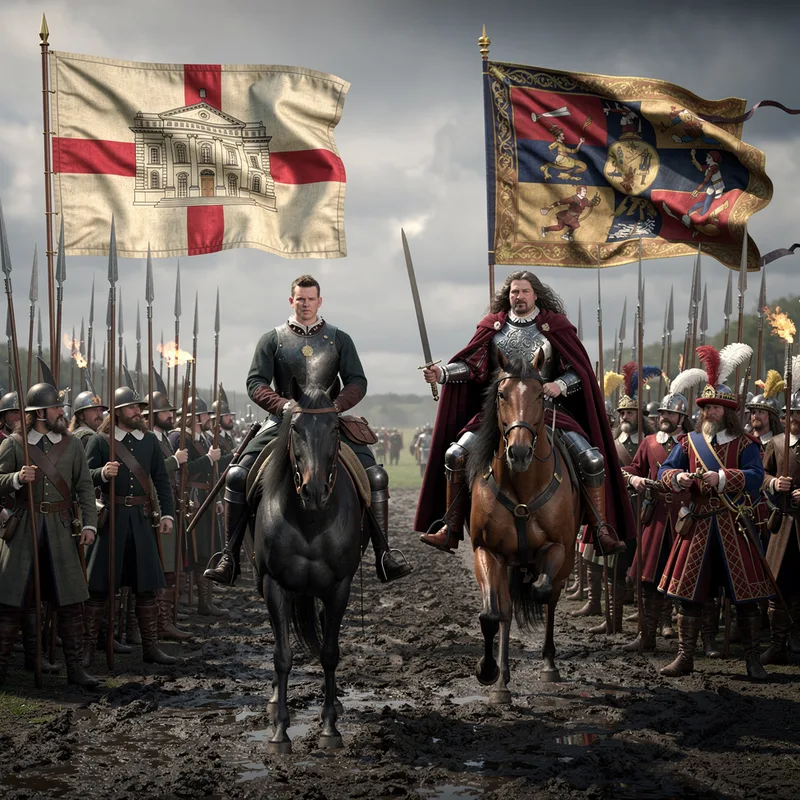
English Civil War
 1
6.0
1
6.0

- proper noun
- In the aftermath of the English Civil War, an official serving Charles II complained: "The press makes the multitude too familiar with the actions and counsels of their superiors..."
Loading YouTube…
Watch on YouTubeHobbs was was struck in part by, you know, the need for social order in watching an English Civil War unfold.
- Hobbs was was struck in part by, you know, the need for social order in watching an English Civil War unfold.
- He is talking about the English Civil War in which there was such a breakdown.
- Obviously Boris Johnson, he's not enacting some version of the English Civil War.
Examples
-
The English Civil War was a pivotal conflict that reshaped the governance of England.
-
There are a few specials interspersed there, including one dedicated to the English Civil War, which our Roundhead friend above referenced.
Blog text (28) -
He is talking about the English Civil War in which there was such a breakdown.
-
What would you call the Levellers and the Diggers of the English Civil War, for example?
Blog text (26) -
However, English philosopher Thomas Hobbes expanded on the idea when he wrote Leviathan in response to the English Civil War.
Blog text (33) -
This pocket watch was found in the 1990s on the wreck of the Swan, a ship that sank in 1653 during the English Civil War.
Academic text (2011) -
By this stage, we are in the midst of the English Civil War, with our ancestor bankrolling the King's war effort against the parliamentarians.
Blog text (24) -
There is also a book "The Cousins' Wars" by Kevin Philips that looks at this Protestant identity as it played out in both the English Civil War and the American Revolution.
Blog text (29) -
In the period after the English Civil War, the monarchy and its supporters felt threatened by the discourse occurring in coffeehouses, and King Charles II made an unsuccessful attempt to suppress their existence.
Academic text (2018) -
During the English Civil War, battles between the Royalists and Parliamentarians resulted in significant loss of life.
Surface Forms
Morphology
The meaning is directly built from the constituents: 'English' (pertaining to England) + 'civil' (internal/domestic, among citizens) + 'war' (armed conflict), so a learner who knows the words will infer it refers to a war within England between domestic groups. Specific historical details (dates, factions) aren’t predictable from the words, but the core referential meaning is compositionally transparent.
Etymology
English Civil War refers to a war in England where people from the same country fought each other. The word Civil means 'between citizens' rather than against another country, and the fight between supporters of Parliament and supporters of the King led to the temporary overthrow of the monarchy.