

Eastern Roman Empire


 1
6.9
1
6.9
- noun
- The Eastern Roman Empire, also known as the Byzantine Empire, preserved Greek and Roman knowledge for centuries.
Examples
-
Many scholars agree that the Eastern Roman Empire played a crucial role in shaping the history of Europe.
-
By this time, the Eastern Roman Empire, what we're talking about as the East, is pretty much a Greek empire.
-
Well, the last Eastern Roman Empire emperor actually to put in an appearance in Rome.
-
Unfortunately, most people wouldn't know what you were talking about if you spoke of the Eastern Roman Empire.
Blog text (6) -
One interesting thing about the article is that it credits Greek Fire with extending the shelf life of the Eastern Roman Empire.
Blog text (24) -
In fact, the Renaissance was the direct product of Crusaders bringing Muslim texts back to Europe from the Near East and the Eastern Roman Empire.
Blog text (14) -
In 1204, events had conspired to lead the Fourth Crusade off its path, ending with its capture of Constantinople from the Eastern Roman Empire and the establishment of the so-called Latin Empire.
Blog text (32) -
After the fall of Constantinople, the Eastern Roman Empire officially came to an end in 1453.
Synonyms
 3
9.9
3
9.9
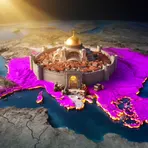
The eastern part of the Roman Empire after 395 AD that was based in Constantinople
 1
6.3
1
6.3
The eastern part of the Roman Empire centered on Constantinople that lasted from about 395 to 1453
Surface Forms
Morphology
The phrase is compositionally built from 'eastern' + 'Roman' + 'empire' and directly denotes the eastern part of the Roman Empire, so a B1 learner who knows the constituents can infer this basic meaning. Cross-linguistic equivalents and the transparent noun-noun composition make the referent obvious, though specialised historical nuances (e.g. the term Byzantine Empire) may require additional background knowledge.
Etymology
Eastern Roman Empire is the name for the eastern half of the old Roman world after the empire split in 395 AD. Its capital was Constantinople and it kept going for many centuries after Rome fell, so it is often called the 'Byzantine Empire'.