

Chinese cabbage


 1
2.3
1
2.3
- noun
- /ˈtʃaɪniːz ˈkæbɪdʒ/
- Don't put Chinese cabbage in the salad.
- Chinese cabbage and pak-choi
- Napa cabbage (Chinese cabbage)
- Chinese cabbage and bok
Examples
-
The greens consisted of Chinese cabbage and the leaves and tiny buds of kikuna, edible spring mums.
Fiction book (1991) -
Sometimes we receive some Chinese cabbage or fish.
Fiction book (1999) -
- I boil the Chinese cabbage...
-
Chinese cabbage (Brassica rapa) in particular was cultivated throughout the year.
Academic text (2018) -
"And what's this?" Mitch lifted a torpedo-shaped vegetable that resembled Chinese cabbage, glittering with moisture.
Fiction book (1997) -
I love adding Chinese cabbage to my stir-fry for extra crunch and flavor.
-
For dinner, she prepared a soup with Chinese cabbage, tofu, and garlic.
-
You can find Chinese cabbage among the other vegetables at the Asian grocery store.
Synonyms
 29
7.5
29
7.5
A long, pale green Chinese cabbage used in cooking

A leafy vegetable like a cabbage used in East Asian cooking
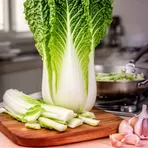
A leafy vegetable like cabbage with long white stems used in Asian cooking

A pale cabbage with tightly packed leaves used in East Asian cooking

A vegetable with a long head and crisp stalks like celery used in East Asian cooking
Surface Forms
Morphology
The meaning 'a type of cabbage associated with China / used in Chinese cuisine' is directly and transparently derived from combining 'Chinese' (origin/association) with 'cabbage' (a leafy vegetable). This adjective + noun composition is a common, cross-linguistic pattern, so a B1 learner who knows both constituents will readily infer the MWE's meaning.
Etymology
Chinese cabbage uses Chinese to show the plant came from China and cabbage to show it is a kind of leafy plant, so today Chinese cabbage simply means the long, pale 'vegetable' often used in many Asian dishes.