
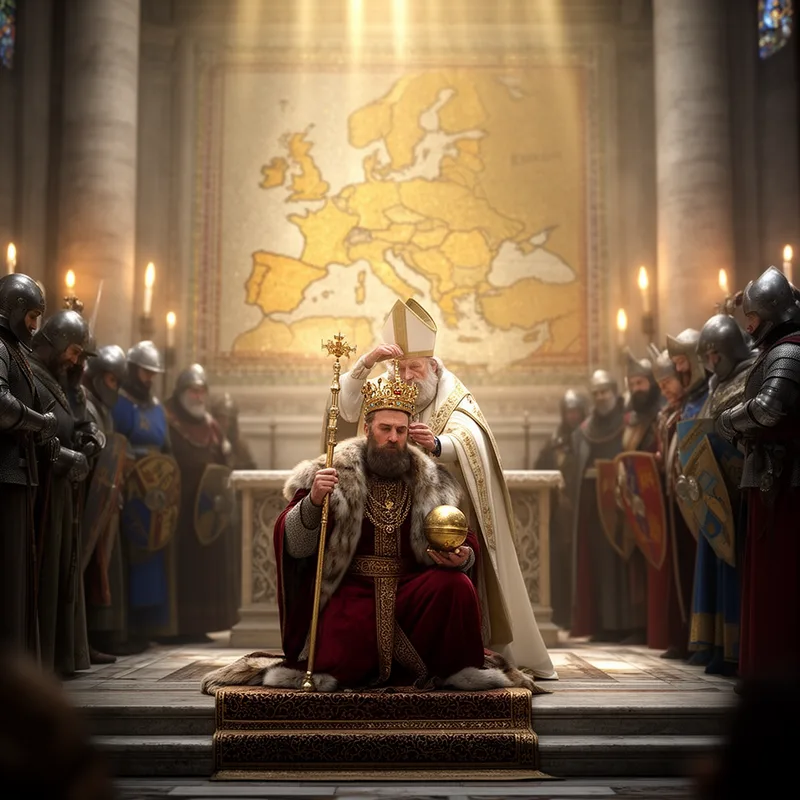
Charles I
- proper noun
- The coronation of Charles I marked the beginning of the Carolingian Empire.
Examples
-
Charles I expanded his empire by conquering the Lombards and the Saxons.
-
Medieval Europe changed drastically during the reign of Charles I.
-
Charles I reigned!
-
Did Charles I unite Western Europe?
-
Charles I is often credited with uniting Western Europe during his reign as Holy Roman Emperor.
-
The significant reforms initiated by Charles I transformed the political landscape of medieval Europe.
-
Historians frequently study the achievements of Charles I, particularly in relation to the Carolingian Empire.
Synonyms

 6
8.8

A king in the Middle Ages known for uniting much of western and central Europe and becoming emperor
 1
7.9
King of the Franks who became Holy Roman Emperor and united much of western and central Europe
Surface Forms
Morphology
Charles + I
This is a referential proper name: 'Charles' is a personal name and 'I' only signals 'the first', but neither element conveys the biographical identity or role (king/emperor) of the referent. Proper names are not compositional in this way, so a B1 learner who knows the constituent words would not be able to infer that this refers to Charlemagne or his historical status.
Etymology
Charles I here is 'Charlemagne', usually called Charles the Great. Picture a king who joined many lands under one rule and was crowned emperor by the pope; that's why this Charles I is remembered as the great ruler who shaped early medieval Europe.