
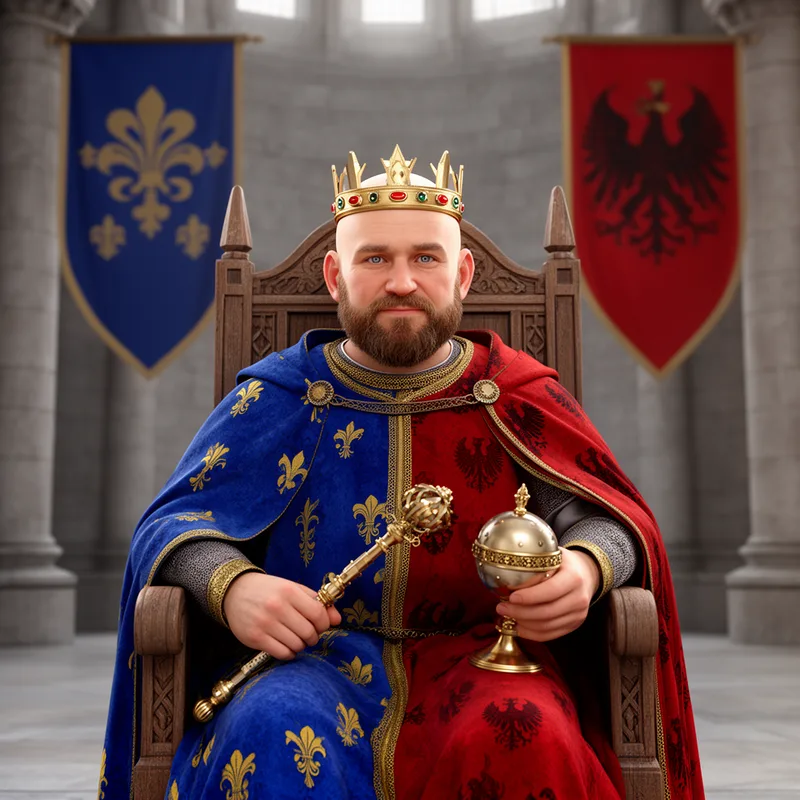
Charles I


 1
8.4
- proper noun
- King Charles I, known as Charles the Bald, ruled France during the 9th century.
Examples
-
Charles I, who was also called Charles the Bald, became Holy Roman Emperor after his reign as King of France.
-
Historical records show that Charles I played a significant role in the political landscape of medieval Europe.
-
-Did he mention Charles I?
-
Yes, King Charles I does creep in.
-
I see you're writing stories about Charles I.
-
King Charles I.
-
He believes when Charles I was executed, the king's troubles flew from his head to nest in Mr Dick's own.
-
After Charles' death, Edmund Hall argued that "Charles I was not Antichrist, as 'tis commonly taught, but one of the Witnesses slain for the truth; after three years according to prophecy, he would rise again in the person of Charles II."
Blog text (12) -
Henry Hammond (1605–1660) was an English churchman and scholar, and a friend of King Charles I.
Blog text (12)
Synonyms
 1
8.9
A king of the Franks who became Holy Roman Emperor in the 800s
Surface Forms
Morphology
Charles + I
This is a referential proper name: 'Charles' is a personal name and 'I' only signals 'the first', but neither element conveys the biographical identity or role (king/emperor) of the referent. Proper names are not compositional in this way, so a B1 learner who knows the constituent words would not be able to infer that this refers to Charlemagne or his historical status.
Etymology
Charles I was a 9th-century king of West Francia often called Charles the Bald. Picture a ruler nicknamed 'the Bald' — that image helps you remember him, and he later became Holy Roman Emperor called 'Charles II', so this Charles I is the French king who also took an imperial title.