
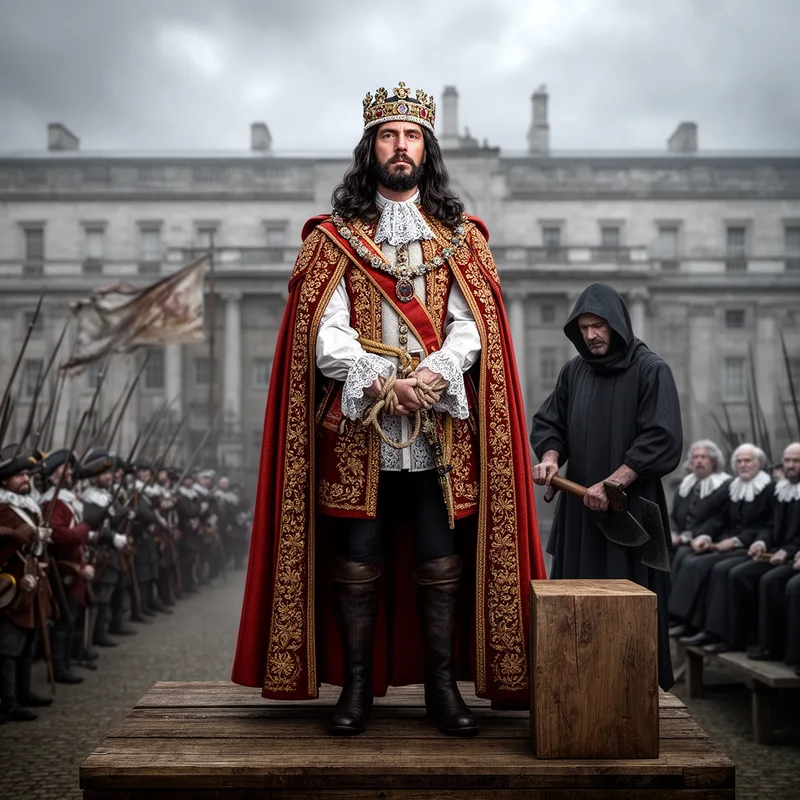
Charles I
 1
7.2

- proper noun
- James VI/I effectively balanced affairs between the two kingdoms, but Charles I lost what his father had attempted to retain.
Examples
-
On the morning of his execution, King Charles I put on two shirts.
-
In response to the rebellion, Charles I dissolved Parliament, and the religious and political sides of the rebellion joined forces.
Academic text (2006) -
The original was sold after the execution of Charles I and went into the collection of Cardinal Mazarin.
-
This position was reached by James I as early as 1610 and by Charles I in 1626.
Academic text (2011) -
Charles I attempted to bring the Scots more into line with his other subjects and began a process of Anglicization.
Academic text (2006) -
When the Rump Parliament determined to execute Charles I, they acted on their sentence without any input from the Scots.
Academic text (2006) -
However, Russell believed that the threat of extinction only became a reality after the accession of Charles I, when it became clear that the Commons was unwilling to pay the full cost of war with Spain and France.
Academic text (2011) -
During the reign of James' successor, Charles I, this library was confiscated in order to suppress what was in effect an early 'think tank' bent on clipping the king's wings with their own interpretation of historical precedent.
Academic text (2011) -
I see you're writing stories about Charles I.
-
When the Rump Parliament determined to execute Charles I, they acted on their sentence without any input from the Scots.
Synonyms

 1
8.9
A king of England, Scotland, and Ireland removed and executed in 1649 during the civil war
 1
8.0
King of England, Scotland and Ireland from 1625 until his execution in 1649
Surface Forms
Morphology
Charles + I
This is a referential proper name: 'Charles' is a personal name and 'I' only signals 'the first', but neither element conveys the biographical identity or role (king/emperor) of the referent. Proper names are not compositional in this way, so a B1 learner who knows the constituent words would not be able to infer that this refers to Charlemagne or his historical status.
Etymology
Charles I was the king of England whose fight with Parliament led to his trial and 'execution'. Imagine a ruler who would not share power and was put on trial; that's why this Charles I is remembered for starting the 'English Civil War' and for his death.