
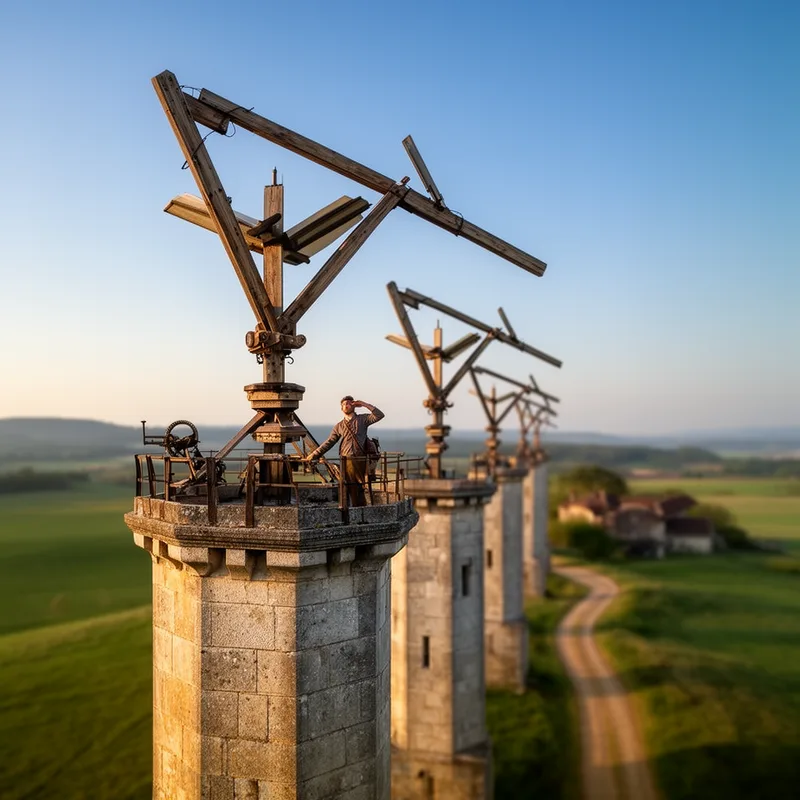
Chappe telegraph
- noun
- Archaic
- The Chappe telegraph revolutionized long-distance communication in France during the late 18th century.
Examples
-
Many towers from the original Chappe telegraph network can still be found across the French countryside.
-
Before the electric telegraph, armies relied on the Chappe telegraph for rapid transmission of important messages.
-
The Chappe telegraph revolutionized long-distance communication.
-
Have you ever seen a Chappe telegraph in action?
-
Before the electric telegraph, armies relied on the Chappe telegraph for rapid transmission of important messages.
-
Many towers from the original Chappe telegraph network can still be found across the French countryside.
-
The Chappe telegraph revolutionized long-distance communication in France during the late 18th century.
Synonyms

A tower with moving arms that shows messages to people far away

A line of towers with moving shutters that send messages people can see over long distances
Surface Forms
Morphology
Chappe + telegraph
Because 'Chappe' is a proper name and 'telegraph' is a known signaling device, a B1 learner who knows both words would infer this is a type or instance of telegraphy (i.e., a communication device). However, the specific mechanism (a tower with pivoting shutters used for visual signalling) and historical sense are not derivable from the constituents alone, so the relation is only partially transparent.
Etymology
Chappe telegraph is named after Claude Chappe, who built tall towers with big moving arms on top that could form different shapes for people in the next tower to read. By reading each shape in turn, they could 'send messages' quickly across long distances, so the name refers to that early 'visual signalling' system used before the electric telegraph.

