

Cervus elaphus canadensis
- noun
- /ˈsɜrvəs ɪˈlæfəs kəˈnædɛnsɪs/
- Specialized
- Wildlife biologists study the migration patterns of Cervus elaphus canadensis to better understand their behavior.
Examples
-
The Cervus elaphus canadensis roams the forests and grasslands of North America.
-
Look at that large Cervus elaphus canadensis grazing in the meadow!
-
In some regions, Cervus elaphus canadensis is also referred to as the North American elk.
-
The Cervus elaphus canadensis is often found in the Rocky Mountains.
-
In some regions, Cervus elaphus canadensis is also referred to as the North American elk.
-
The Cervus elaphus canadensis roams the forests and grasslands of North America.
-
Wildlife biologists study the migration patterns of Cervus elaphus canadensis to better understand their behavior.
Synonyms

 32
1.0
32
1.0

A large North American deer with light brown fur and branching antlers in males
 1
9.1
1
9.1
A large North American deer with big antlers and a light patch on its rear
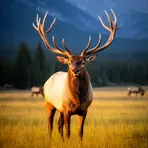
A large North American deer whose male has big branching antlers
Surface Forms
Morphology
Cervus + elaphus + canadensis
The phrase is a scientific Latin binomial: 'Cervus' names a deer genus and 'canadensis' signals Canadian origin, so a learner who knows those parts could infer it refers to a Canadian/North American deer. However, 'elaphus' is obscure to a B1 learner and taxonomic Latin naming is domain-specific, so the full referent (elk/wapiti) is not reliably predictable without prior exposure.
Etymology
The name Cervus elaphus canadensis comes from Latin and old Greek words: Cervus means 'deer', elaphus means 'stag', and canadensis shows it is 'from Canada'. Picture a large stag with wide, branched antlers in North American forests, and you can see why this name refers to the big elk native to North America.