
Castanea dentata
- noun
- /kæˈsteɪniə dɛnˈteɪtə/
- Specialized
- The blight nearly wiped out the majestic Castanea dentata forests in the early twentieth century.
Examples
-
Botanists are working to restore populations of Castanea dentata throughout its native range.
-
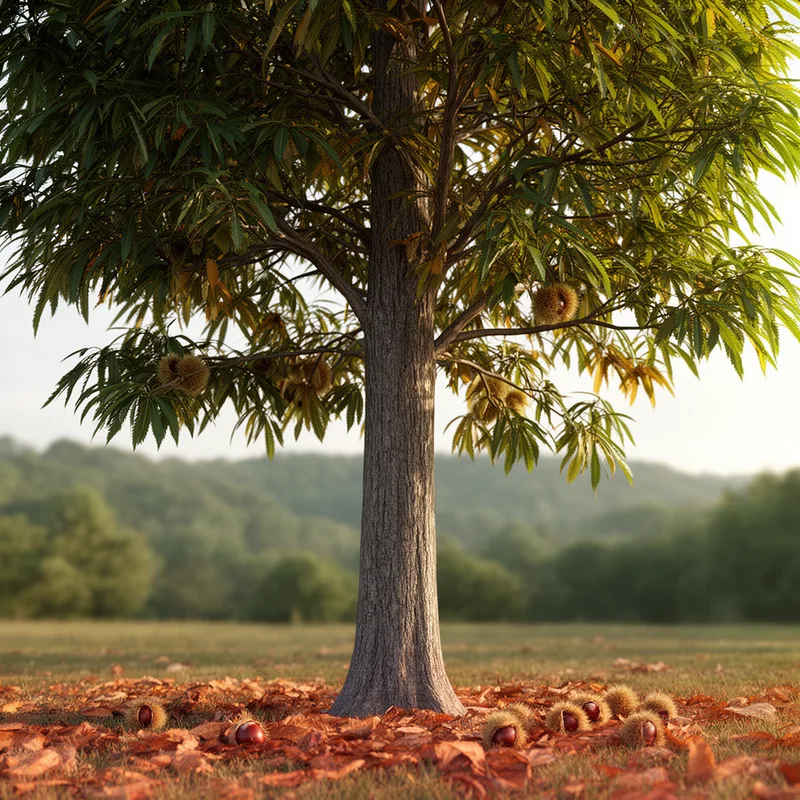
Leaves from Castanea dentata are easily recognized by their long, serrated edges.
-
The Castanea dentata was once a dominant tree in the eastern forests.
-
Many people are trying to restore the Castanea dentata population.
-
Botanists are working to restore populations of Castanea dentata throughout its native range.
-
The blight nearly wiped out the majestic Castanea dentata forests in the early twentieth century.
-
The Castanea dentata tree was once abundant from Maine to Alabama.
Synonyms


 1
5.7
1
5.7
A large eastern North American tree that makes edible nuts and strong wood

A large tree from eastern North America that makes sweet edible nuts and useful wood
Surface Forms
Morphology
The name is transparently built as a Latin binomial (genus Castanea + adjective dentata meaning 'toothed'), so a learner who knows those constituents can infer it denotes a species of chestnut with toothed/serrated margins. However, full comprehension (that it specifically refers to the American chestnut and its native range) relies on taxonomic and cultural knowledge beyond simple compositional meaning, making it partially but not fully predictable for a B1 learner.
Etymology
Castanea dentata comes from old Latin names: Castanea means 'chestnut' and dentata means 'toothed', because the tree's leaves have many sharp, tooth-like edges. So the name simply describes the American chestnut tree and helps you picture its toothed leaves.