
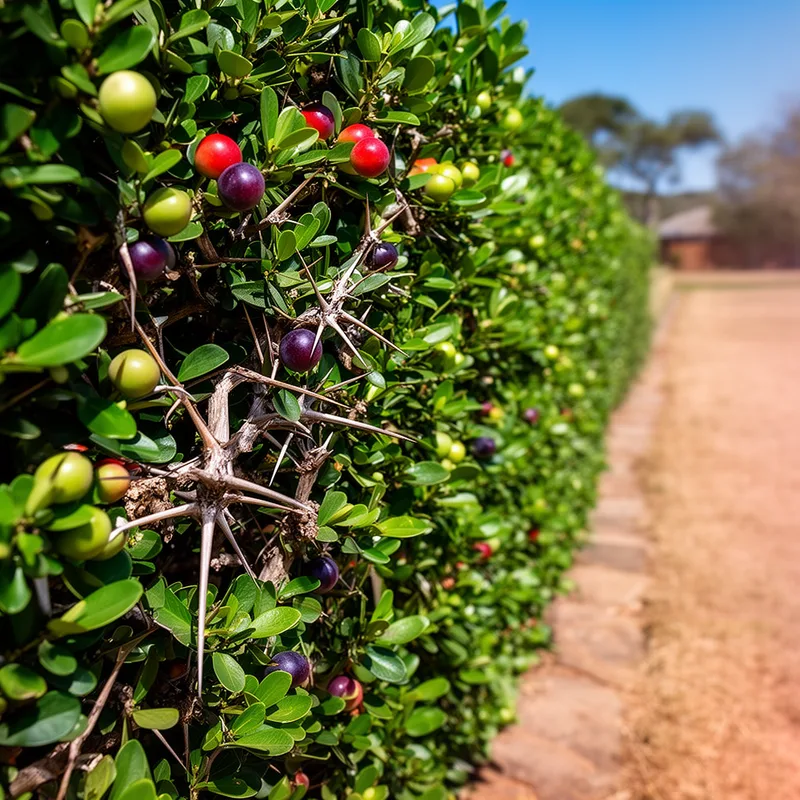
Carissa bispinosa
- noun
- Specialized
- The fruit of Carissa bispinosa is edible and resembles a small plum.
Examples
-
The thick branches of Carissa bispinosa make it an excellent choice for natural hedges.
-
The Carissa bispinosa is commonly found in South Africa.
-
Many gardeners in South Africa plant Carissa bispinosa to create protective borders.
-
You can use Carissa bispinosa for effective hedging.
-
Many gardeners in South Africa plant Carissa bispinosa to create protective borders.
-
The fruit of Carissa bispinosa is edible and resembles a small plum.
-
The thick branches of Carissa bispinosa make it an excellent choice for natural hedges.
Synonyms

A South African bush with sharp forked branches and fruit like small plums often planted as a fence

A large evergreen shrub from South Africa with shiny leaves, thorny branches, and red fruit used as a hedge
Surface Forms
Morphology
Carissa + bispinosa
This is a Latin binomial where the genus name 'Carissa' (a spiny shrub) combined with a descriptive species epithet typically encodes a morphological trait; 'bispinosa' can be parsed as bi- (two) + spinosa (spined), so the compound meaning ('a Carissa with two/forked spines') is compositionally derivable. However, decoding the Latin roots requires knowledge of classical/technical morphology that an average B1 learner is unlikely to have, so the relation is partially transparent but not immediately predictable.
Etymology
Carissa bispinosa gets its name from how it looks: the second part bispinosa means 'two spines', a clear picture of its forked thorns, and the shrub also bears small, plum-like fruit. So, because of its thick, thorny branches gardeners plant it as a natural 'hedge' to protect their gardens.

