
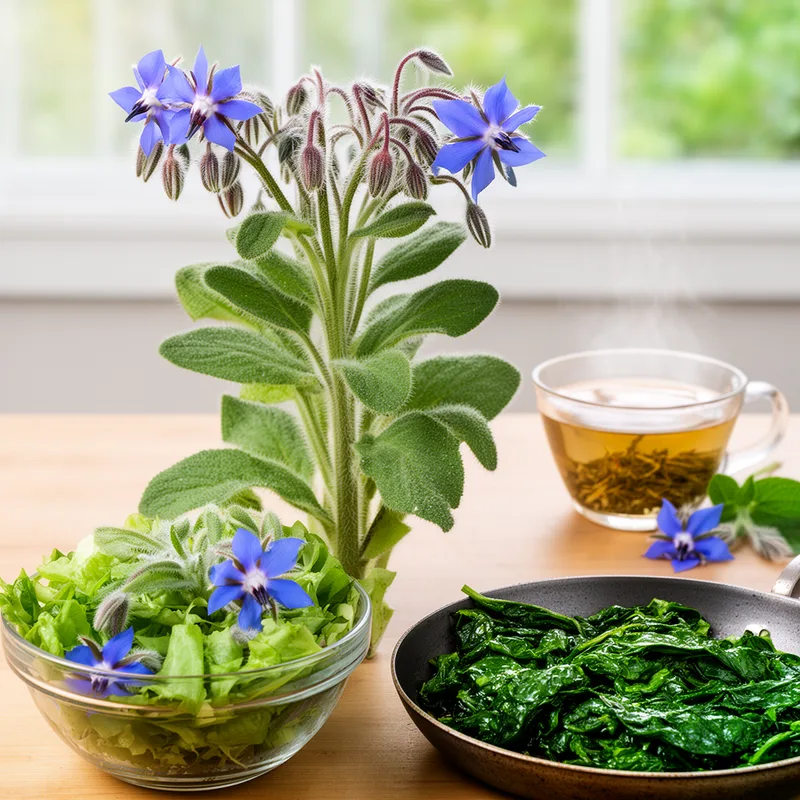
Borago officinalis
- noun
- Specialized
- Gardeners grow Borago officinalis both for its edible leaves and its attractive blue flowers.
Examples
-
Herbalists sometimes recommend Borago officinalis as a remedy for inflammation.
-
I love adding Borago officinalis to my salads.
-
Borago officinalis is often added to salads for its cucumber-like flavor.
-
Have you ever tried Borago officinalis in your cooking?
-
Borago officinalis is a popular herb used in salads due to its unique cucumber-like taste.
-
In herbal medicine, Borago officinalis is valued for its medicinal properties and used to treat various ailments.
-
Many chefs incorporate Borago officinalis as a flavorful ingredient in both salads and cooked dishes.
Synonyms

 1
9.4
1
9.4

A yearly herb with hairy leaves and blue star-shaped flowers used in salads and medicine

A hairy plant with blue flowers from Europe that people eat like spinach
Surface Forms
Morphology
The binomial combines the genus name 'Borago' (an herb) with the Latin adjective 'officinalis' which conventionally marks species with medicinal uses, so a learner who knows both constituents can infer this refers to the medicinal form of Borago. This follows a regular botanical naming pattern (cross-linguistically recognizable in scientific nomenclature), so the core meaning is compositionally derivable even if specific botanical details are not.
Etymology
Borago officinalis may come from an old Latin word Borago that meant something like 'wool' or 'hair', because the plant has very hairy leaves. The second word, officinalis, was used for plants sold in old medicine shops, so together the name points to a hairy herb people used as a remedy and also ate in salads.