

Battle of Passchendaele
- noun
- /ˈbætəl əv ˈpæʃənˌdeɪl/
- The failure of the Allies to achieve their goals at the Battle of Passchendaele is often discussed by historians.
Examples
-
The Battle of Passchendaele became infamous for the horrific conditions and massive loss of life.
-
Many soldiers wrote about their experiences during the Battle of Passchendaele in letters home.
-
The Battle of Passchendaele was one of the bloodiest battles in history.
-
Many soldiers fought bravely in the Battle of Passchendaele.
-
The 1917 Battle of Passchendaele was infamous for its muddy conditions and high number of casualties.
-
Many historians regard the Battle of Passchendaele as a significant event in World War I due to its brutal tactics.
-
During the Battle of Passchendaele, soldiers struggled against both the enemy and the relentless waterlogged fields.
Synonyms


 1
9.9
1
9.9
A World War I battle in 1917 known for mud and mustard gas
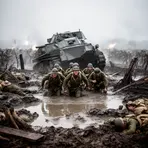
A major World War I battle in 1917 at Passchendaele known for mud and many deaths

A series of battles near Ypres in Belgium during World War I that included the first use of mustard gas
Surface Forms
Morphology
battle + of + Passchendaele
The form 'battle of [place]' is compositionally clear: a B1 learner who knows 'battle' and 'of' will infer it denotes a fight at Passchendaele, so the basic locative meaning is predictable. However, the specific historical sense (a major 1917 WWI engagement with waterlogged conditions, mustard gas, and heavy casualties) is not derivable from the constituents and 'Passchendaele' as a proper name does not convey those details, so the expression is only partially transparent.
Etymology
Battle of Passchendaele is named after the village of Passchendaele in Flanders, where Allied and German forces fought in 1917. Heavy rain, shell holes full of water and poison gas turned the fields into deep mud where men and horses often sank, so the name now brings to mind 'horrific conditions' and great loss of life.