
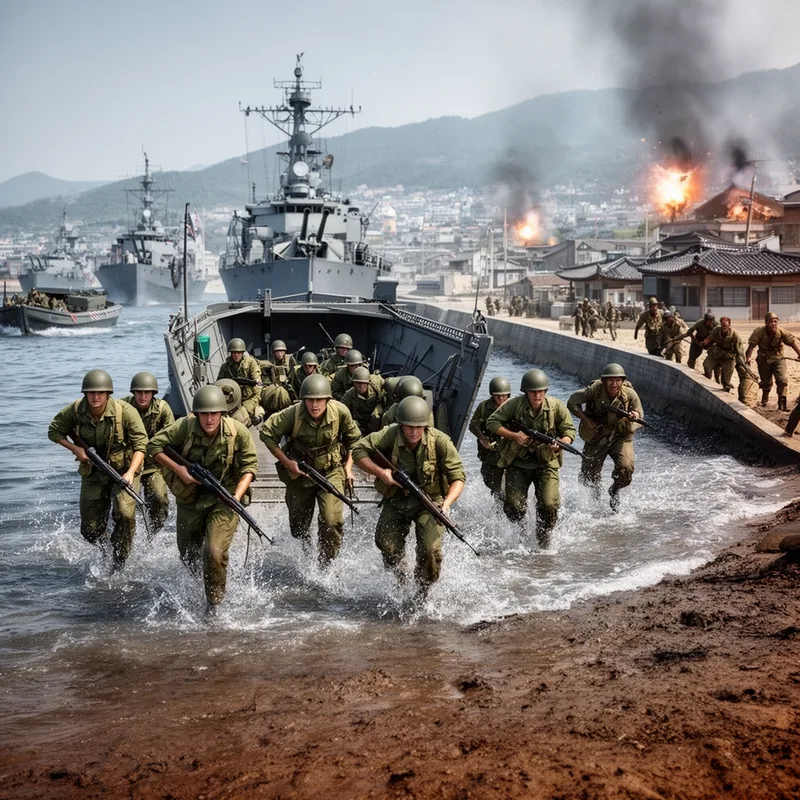
Battle of Inchon


 1
7.8
- proper noun
- Many historians consider the Battle of Inchon one of the most brilliant military operations of the twentieth century.
Examples
-
The Battle of Inchon marked a turning point in the Korean War, allowing UN forces to recapture Seoul.
-
General MacArthur planned the Battle of Inchon as a daring amphibious assault against the North Korean army.
-
The Battle of Inchon was a turning point in the Korean War.
-
Did you learn about the Battle of Inchon in history class?
-
The United States successfully executed an amphibious assault at the Battle of Inchon in 1950.
-
The Battle of Inchon marked a turning point in the Korean War with its strategic landing.
-
During the Battle of Inchon, Allied forces launched a surprise attack that led to a significant victory.
Synonyms
 1
8.2
A 1950 Korean War battle when United Nations forces landed at Inchon and gained an advantage
Surface Forms
Morphology
This is fully compositional: 'battle' + 'of' + the place name 'Inchon' denotes a military engagement at that location, so a B1 learner who knows the constituents will understand it refers to a battle that took place in Inchon. While specific historical details (year, forces involved, outcome) cannot be derived from the phrase, the core referential meaning is transparent and predictable across languages.
Etymology
Battle of Inchon is named for the risky landing from the sea at Inchon in 1950, when ships and soldiers came ashore at a narrow port with strong tides and surprised the enemy. That's why the name brings to mind a 'daring' attack that was a 'turning point' in the Korean War.