
Bacillus subtilis
- noun
- /bəˈsɪləs ˈsʌbtɪlɪs/
- Specialized
- Similarly, spore-forming and vegetative Bacillus subtilis were used as surrogates for Gram-positive bacilli such as Bacillus anthracis.
Examples
-
Similarly, spore-forming and vegetative Bacillus subtilis were used as surrogates for the Gram-positive bacilli such as B. anthracis.
Academic text (2003) -
The enzyme is secreted by the common bacterium Bacillus subtilis.
Academic text (1993) -
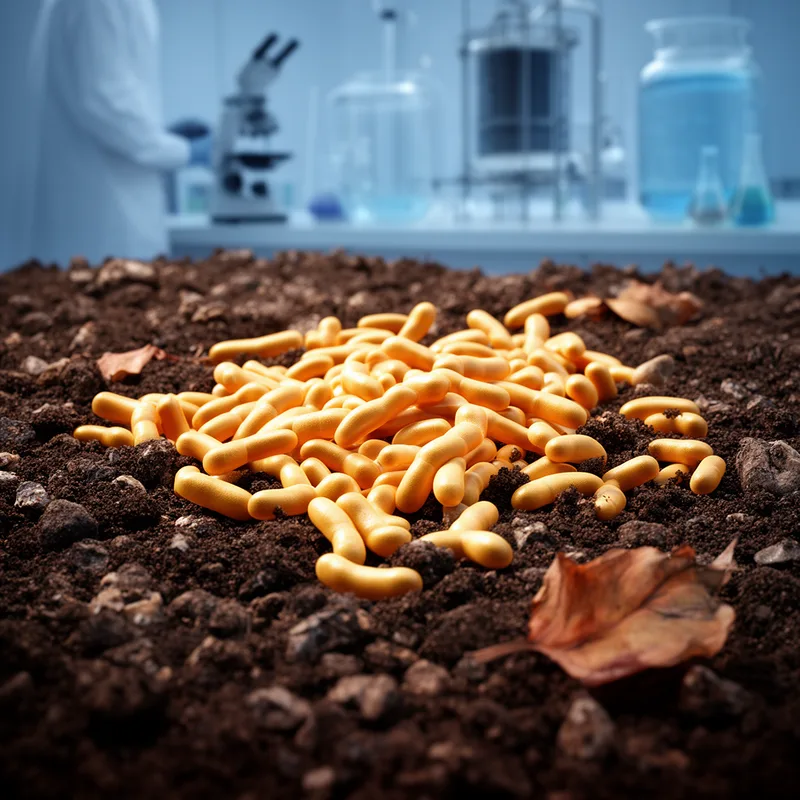
Bacillus subtilis (left) is found in most soils.
Academic text (2000) -
Last year, Bacon and Hinton found that a strain of Bacillus subtilis fills up corn's intercellular spaces before F. moniliforme gets the opportunity.
Academic text (2000) -
The bacterium Bacillus subtilis is often used in laboratory experiments due to its unique properties.
-
Researchers are studying Bacillus subtilis to develop new antibiotics that can fight resistant bacteria.
-
In nature, Bacillus subtilis thrives in soil, playing a vital role in the decomposition of organic matter.
Synonyms

A common soil bacterium that breaks down dead plants and sometimes makes antibiotics

A common soil bacterium that helps plants grow and can make antibiotics
Surface Forms
Morphology
bacillus + subtilis
The element 'bacillus' clearly signals a rod-shaped bacterium, so a learner who knows that word will infer this is a type of bacterium; however 'subtilis' is a Latin species epithet (not a common English word and not listed here) and does not transparently convey the specific properties (gram-positive, soil-dwelling, used in research) of this taxon. Because the genus gives partial, predictable information but the full, technical meaning requires specialist knowledge of species names and microbiology, the expression is only partially transparent to a B1 learner.
Etymology
Bacillus subtilis comes from Latin words: Bacillus meaning 'little rod' and subtilis meaning 'slender'. So, the name gives a simple picture of a thin, rod-shaped bacterium that lives in soil.

