
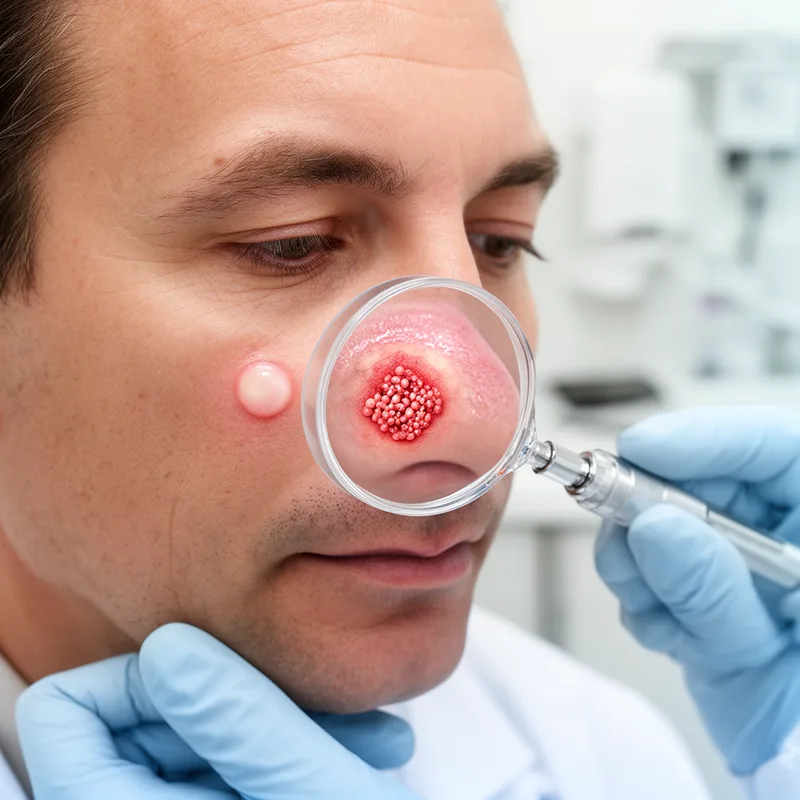
BCC
- noun
- /biː siː siː/
- Specialized
- Incisional biopsy results were BCC for all patients preoperatively.
- BCC (basal cell carcinoma)
- basal cell BCC
- basal cell BCC
Examples
-
The most common site for BCC in our study was the face, followed by head and neck.
Academic text (2007) -
Basal cell carcinoma (BCC) is the most common skin cancer worldwide and represents 75% of cutaneous malignancies (1).
Academic text (2015) -
In addition, many cases of BCC in Iran are due to previous radiation.
Academic text (2007) -
The prevalence of BCC on the head and neck was even more than on the ears and eyes.
Academic text (2007) -
92% of the BCC cases have occurred after age 40.
Academic text (2007) -
Our results also showed that in Iran, like other countries, the incidence of BCC was more in males than females.
Academic text (2007) -
Most BCCs progress slowly because of apoptosis taking place in tumor cells.
Academic text (2017) -
Fifty-three BCCs in 50 patients were treated by a single plastic surgeon (TH) in a tertiary center.
Academic text (2015) -
The majority of BCCs can be treated using standard techniques, including conventional surgical excision, curettage, cryotherapy, and radiotherapy.
Academic text (2015) -
BCC can usually be treated effectively when detected early.
Synonyms
 30
2.5
30
2.5

A growth of skin cells that can be harmful, often after too much sun
 11
5.8
11
5.8
A cancer that starts in the skin or inner layer of organs

A type of skin cancer that looks like a sore or growth
Surface Forms
Etymology
BCC stands for basal cell carcinoma, where basal means 'base' and cell means 'small unit' of the body. So BCC is a common skin cancer that starts in the base layer of the skin.