

Artemisia cana
- noun
- Specialized
- The silvery appearance of Artemisia cana makes it easy to identify among other shrubs.
Examples
-
Artemisia cana provides important winter food for deer and antelope in the region.
-
Many conservationists recommend planting Artemisia cana to restore native habitats.
-
The Artemisia cana grows abundantly in dry areas.
-
Do you know how to identify Artemisia cana?
-
Artemisia cana is essential for providing shelter and food for various wildlife species in the western United States.
-
Farmers often plant Artemisia cana in their fields to support local wildlife and enhance biodiversity.
-
Due to its silvery leaves, Artemisia cana stands out as a valuable resource for wildlife during the harsh winter months.
Synonyms

A low bushy plant with silver leaves that animals eat and hide in

A low shrub with many branches and pale grey leaves that gives shelter and food to wild animals
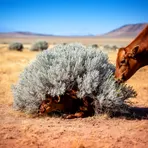
A low bush with pale grey leaves that gives animals shelter and food

A low, many-branched plant with silvery leaves that shelters wildlife
Surface Forms
Morphology
Artemisia + cana
This is a Latin scientific binomial (genus + specific epithet); the second element 'cana' is not an English word and requires botanical/Latin knowledge to interpret. Even if a learner recognized 'Artemisia' as a plant genus, they would not be able to derive the species meaning (silvery sagebrush) from the parts alone, so the term is not transparently compositional for a B1 learner.
Etymology
Artemisia cana comes from the Greek goddess Artemis, because the group name Artemisia is named for her, and from the Latin word cana, which means 'grey' or 'white-haired'. So the name fits the plant's silvery, grey leaves.

