
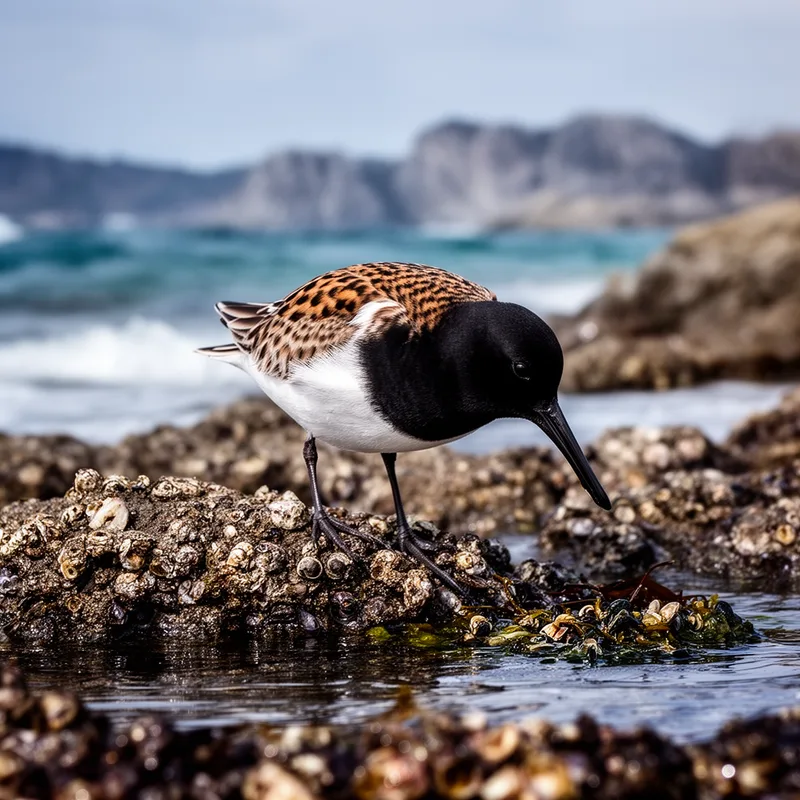
Arenaria melanocephala
- noun
- Specialized
- Birdwatchers flock to the Pacific coast to observe the distinctive Arenaria melanocephala with its black head.
Examples
-
The Arenaria melanocephala is frequently spotted along rocky Pacific coastlines searching for food.
-
The Arenaria melanocephala is commonly seen along the Pacific coast.
-
During migration season, birdwatchers gather to observe the Arenaria melanocephala in large flocks.
-
Unlike its Atlantic relative, the Arenaria melanocephala prefers the western shores of North America.
-
Have you ever spotted an Arenaria melanocephala in its natural habitat?
-
The Arenaria melanocephala can often be seen foraging on rocky beaches along the Pacific shoreline.
-
During the summer, the Arenaria melanocephala is a common sight for nature lovers in coastal habitats.
Synonyms

A small bird that walks in shallow water with black and white feathers on the Pacific coast

A small shore bird that flips stones to find food
Surface Forms
Morphology
Arenaria + melanocephala
The genus name 'Arenaria' denotes a shorebird (turnstone), so that part is transparent; however 'melanocephala' is a Latin/Greek compound not listed in the dictionary and requires knowledge of roots (melano- = black, -cephala = headed) to infer 'black-headed'. Because inference depends on knowledge of classical roots that a typical B1 learner is unlikely to have, the overall phrase is only partially predictable from its parts.
Etymology
Arenaria melanocephala is a name that paints a simple picture: Arenaria comes from a word for 'sand' or shore and melanocephala means 'black-headed', so the name describes a small shore bird with a dark head and spotted feathers. That's why the name fits this turnstone often seen along the Pacific coast.

