
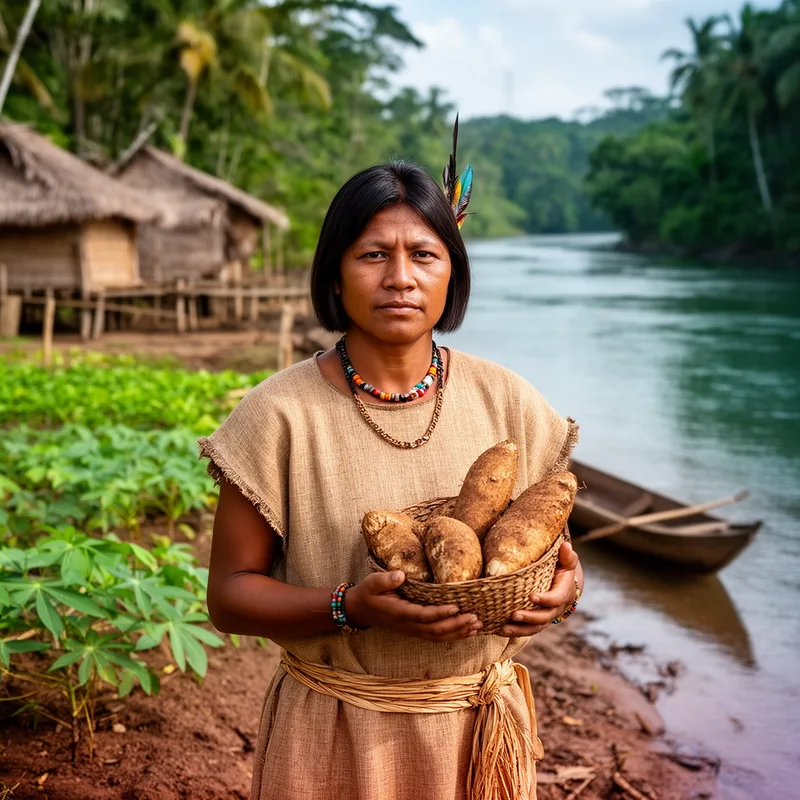
Arawakan
- noun
- /ˌærəˈwɑːkən/
- The Arawakan people have rich cultural traditions that date back thousands of years.
Examples
-
Researchers have studied the Arawakan tribes to learn more about their history and lifestyle.
-
Many Arawakan speakers still preserve their ancestral languages and customs today.
-
Much later, when I played these chants for Jonathan Hill, he noticed that many of Ricardo's chants were in Arawakan and similar to those he had collected among Arawakan speakers in Venezuela.
Academic text (1996) -
Like so many of the most powerful shamans, Ricardo Teixeira had traveled widely in his career, apprenticing among the Arawakan-speaking Baniwa of the Aiari River.
Academic text (1996) -
Ricardo Teixeira, the widely known Wanano shaman from the Uaups River, apprenticed among the Arawakan-speaking Baniwa of the Aiar River.
Academic text (1996)
Synonyms

 1
9.9
1
9.9

A person from a native group in northeast South America or the Caribbean
 1
5.1
1
5.1
A person from the native peoples of South America before European arrival


 1
7.3
1
7.3
A person whose family comes from the native peoples of North or South America
Surface Forms
Morphology
Arawakan = Arawak (transparent) = Arawak + an
Derived by adding the common demonymic suffix '-an' to 'Arawak' to indicate a person belonging to that group, a regular and transparent process.
Etymology
Arawakan can mean a person who belongs to the Arawak peoples. The name comes from what the people called themselves, which is said to mean 'people' or 'men', so an Arawakan is a member of those Indigenous communities.