
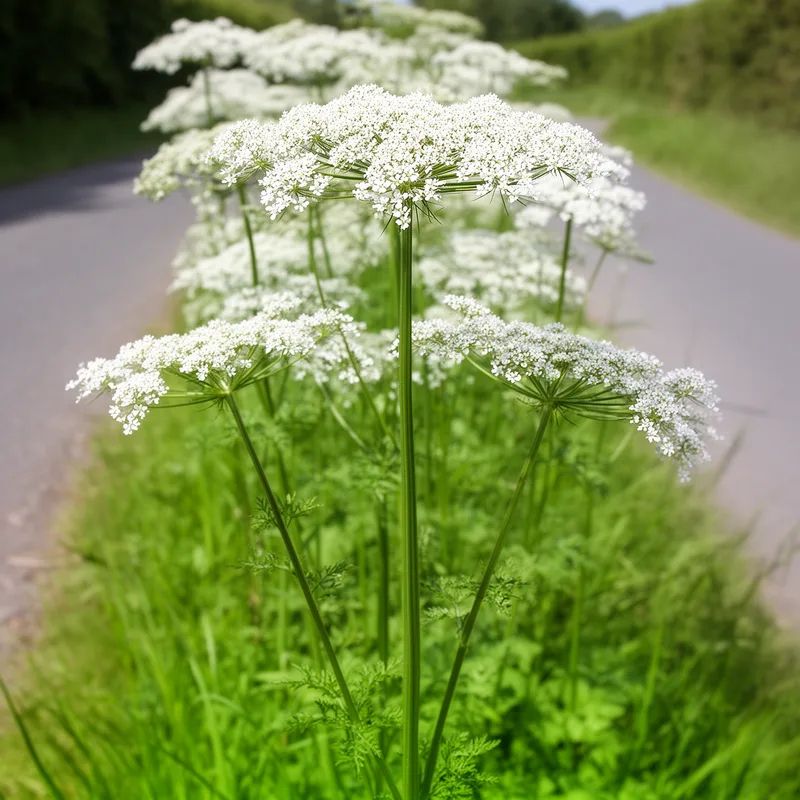
Anthriscus sylvestris
- noun
- Specialized
- Anthriscus sylvestris, commonly known as cow parsley, often flourishes in meadows and alongside roadways.
Examples
-
Gardeners sometimes mistake Anthriscus sylvestris for similar looking plants like poison hemlock.
-
The rapid spread of Anthriscus sylvestris has led to concerns about its impact on local biodiversity.
-
Anthriscus sylvestris often grows along country roads and hedgerows in the spring.
-
The Anthriscus sylvestris grows abundantly in the wild.
-
Have you seen Anthriscus sylvestris near the riverbank?
-
In early summer, Anthriscus sylvestris can be seen blooming with its delicate white flowers.
-
Be careful not to confuse Anthriscus sylvestris with other plants, as it resembles several similar species.
Synonyms
A tall plant with clusters of small white flowers that grows wild by roads and fields
A tall plant with fern-like leaves and white umbrella-shaped flower clusters that often grows as a weed
A plant that grows wild with leaves like parsley or carrot
Surface Forms
Morphology
Anthriscus + sylvestris
This is a scientific binomial combining the genus name 'Anthriscus' with a species epithet; in principle the meaning is compositional (a particular species of Anthriscus). However, correctly interpreting it requires knowledge of taxonomic naming conventions or Latin (e.g. 'sylvestris' ≈ 'of the woods'), which a B1 learner typically lacks, so the connection is only partially transparent.
Etymology
Anthriscus sylvestris is a scientific name that paints a small picture: Anthriscus comes from an old Greek word for parsley-like plants and sylvestris means 'of the woods' or 'wild'. So the name points to the wild, parsley-like plant we often call 'cow parsley'.

