
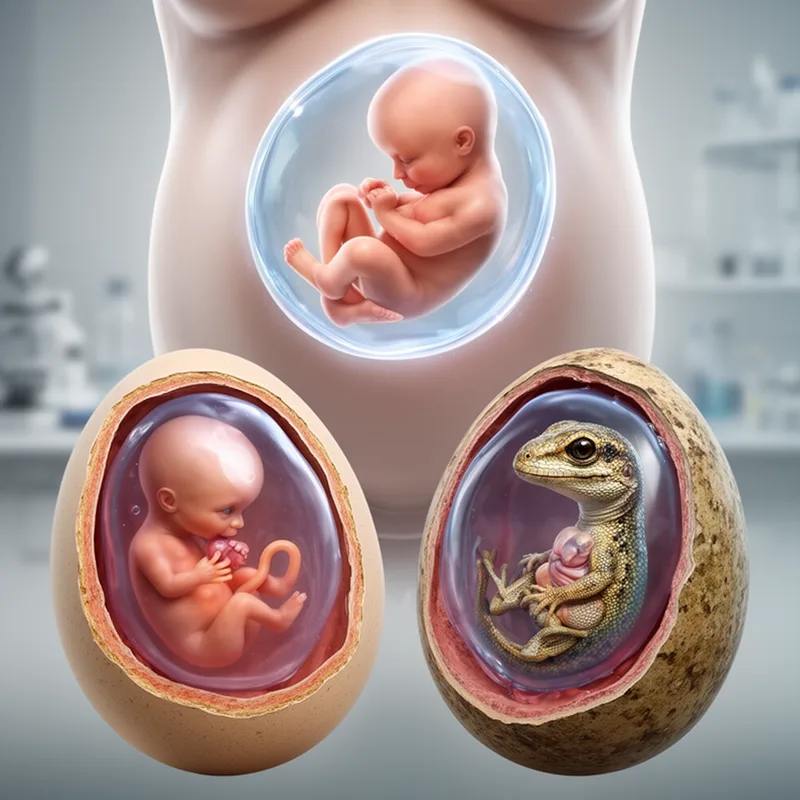
Amniota
- noun
- /æmˈnaɪətə/
- Specialized
- The group of animals known as amniota includes all reptiles, birds, and mammals that share a similar developmental structure.
Examples
-
Our evolutionary roots—the amniota—began a great divergence when a few amniotes crawled out of a primordial sea and left their finned relatives behind.
Academic text (2004) -
And then the amniotes would include the so-called reptiles that would actually be crocodiles, lizards, snakes, turtles.
-
Scientists classify the amniota as a crucial group in understanding the evolution of terrestrial vertebrates.
-
Within the amniota, variations in embryonic development illustrate the adaptations to life on land.
Synonyms


 1
9.9
An animal like a reptile, bird, or mammal whose young develop inside a protective sac
Surface Forms
Morphology
Etymology
Amniota comes from the Greek word amnion, meaning 'membrane' or protective 'sac' around the baby in the egg or womb, and this root may be linked to amnos, meaning 'lamb', because the sac looked like lamb skin. So Amniota are animals that have an amnion, which is why reptiles, birds, and mammals can lay eggs or give birth on land.