
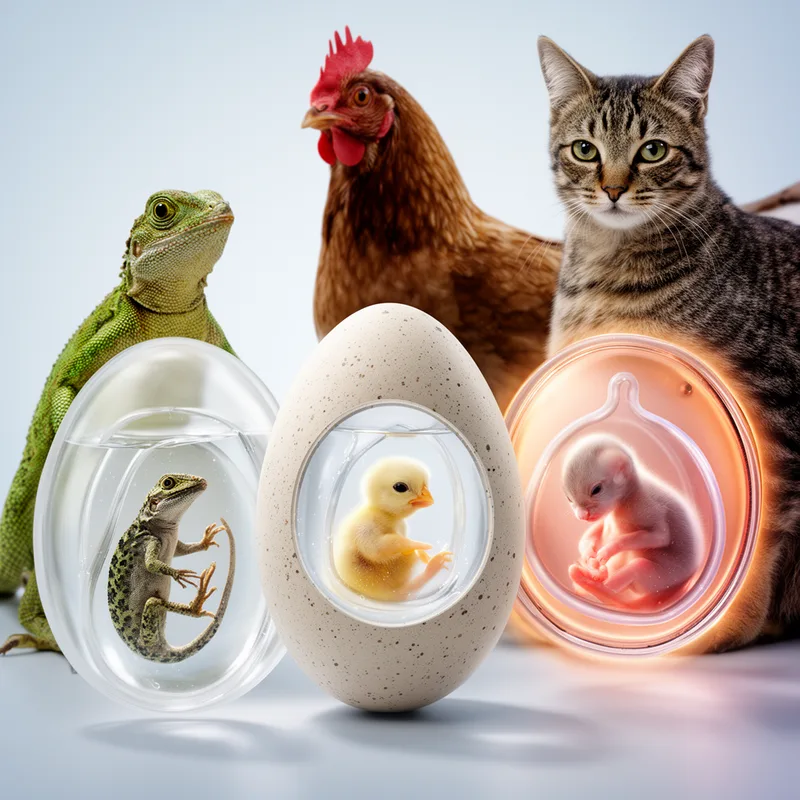
amniote


 1
9.9
- noun
- /ˈæmniˌoʊt/
- Specialized
- To date, the induction of a regeneration blastema, which is a structure with a distal positional identity, remains a future challenge that needs to be solved in amniotes.
Examples
-
Among the group of animals termed the amniotes, which includes birds, mammals, and reptiles, Anolis is the most species-rich genus.
Academic text (2007) -
Generally, amniotes do not have organ-level regeneration ability. This may be attributable to loss of a genetic mechanism regulating regeneration ability.
Academic text (2018) -
We still do not know how to induce a blastema in amniotes.
Academic text (2018) -
HoxA11 has been used as a typical zeugopodial marker gene in amniotes.
Academic text (2018) -
This is clear from well-preserved fossils of early amniotes as well as from many extant amniotes.
Blog text (15) -
It is probable that this better means of expelling carbon dioxide allowed these creatures to become fully independent from the water and contributed to the development of the amniote egg, which was integral to the transition from amphibian to reptile.
Academic text (2003) -
Generally, the amniote ribs grow ventrally into the lateral body wall, whereas in the turtle, they are arrested in the axial part (ax), growing toward the CR.
Blog text (15) -
Although the reason why the intercalary responses cannot be seen in a postembryonic body remains unknown, our findings imply that the common organ-level regeneration inducers can induce regeneration responses in amniotes.
Academic text (2018) -
Our evolutionary roots—the amniota—began a great divergence when a few amniotes crawled out of a primordial sea and left their finned relatives behind.
Academic text (2004) -
Turtles, birds, and mammals are all examples of amniotes because their embryos develop within a protective shell.
Surface Forms
Morphology
Etymology
Amniote comes from the Greek amnion, which meant 'little lamb' and was later used for the thin 'membrane' that surrounds developing young. So an amniote is an animal with an amnion, a protective sac around the embryo, and that is why reptiles, birds, and mammals can have babies on land.