
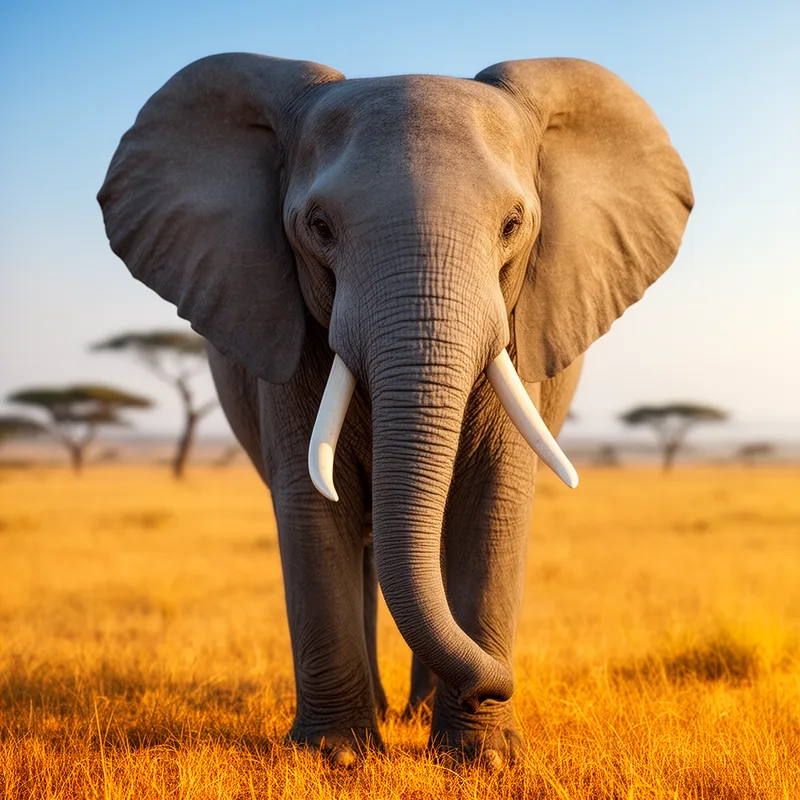
African elephant
 3
1.7
3
1.7

- noun
- /ˈæfrɪkən ˈɛlɪfənt/
- South African
- In January 1990, CITES listed the African elephant as an endangered species, thus forbidding the importation of its ivory into any of the 109 countries that are parties to the CITES treaty.
Examples
-
Depletion in the numbers of an endangered species such as the African elephant may be directly linked to demand for and trade in ivory.
Academic text (1992) -
Hunters knew how difficult it was to bring down a four-ton African elephant—and some of the dinosaurs weighed ten times as much.
Fiction book (1990) -
He's one of the few people in the world to capture an African elephant alive.
-
That's half as much as an adult African elephant.
Academic text (2007) -
Loxodonta africana is the African elephant, which is a species.
Blog text (2) -
She was a little smaller than the rest—no larger than the largest African elephant, a genuine runt.
Fiction book (2002) -
She was fully thirty meters long, five meters tall at the hips, and she weighed twenty tonnes—but then, even the youngsters of the herd, some as young as ten years old, were more massive than the largest African elephant.
Fiction book (2002) -
The African elephant is known for its large ears that help keep it cool in the hot climate.
-
Due to habitat loss, the population of the African elephant has been rapidly declining.
-
At the wildlife reserve, we had the chance to see a family of African elephants roaming freely.
Synonyms
A large African elephant with big ears and long tusks
A group of African elephants, including the bush and forest elephants
Surface Forms
Morphology
The phrase 'African elephant' is a straightforward noun phrase composed of the adjective 'African' (from Africa) modifying the noun 'elephant', so the meaning — an elephant native to Africa — is directly derivable from its parts. This subtype/compositional structure is cross-linguistically common, so an average B1 learner who knows both words will understand the MWE.
Etymology
African elephant is a compound name that joins African, meaning 'from Africa', and elephant, the large animal, to point to the very big elephants that live in Africa. That's why it refers to the large gray elephant with very big ears and ivory tusks.