
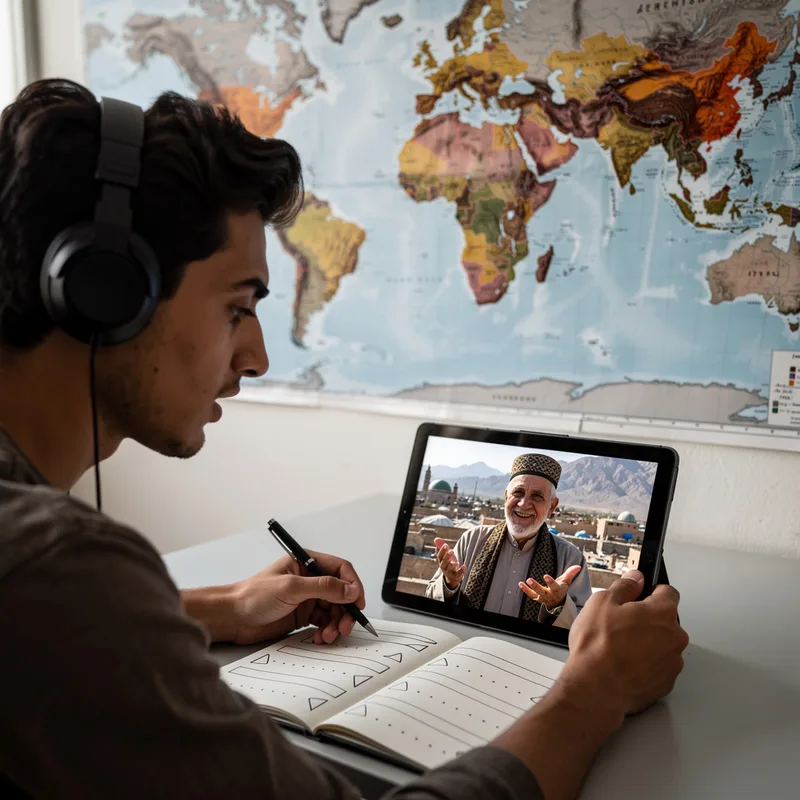
Afghani
 1
8.9
1
8.9

- noun
- /æfˈɡɑːni/
- The ideas of Arab nationalism are rooted in the thought of Islamic modernists like Afghani.
Examples
-
In his anti-imperialist activity, Afghani formulated the ideological basis of Pan-Islam.
Academic text (1995) -
Al-Afghani's pan-Islamic ideas broadly corresponded to the emerging nationalist-cum-Islamic movement against increasing foreign domination.
Academic text (2002) -
Afghani had already taught that under early Islam, liberal principles of consultation and consensus guided the community.
Academic text (1995) -
Al-Afghani used this perspective to explain the decline of Islamic civilization.
Academic text (2002) -
Al-Afghani further argued that "all religions are intolerant, each one in its way."
Academic text (2002) -
Like Afghani, he emphasized the need to interpret and apply reason and deduction to the sacred texts.
Academic text (1995) -
In the nineteenth century, Jamal al-Din al-Afghani (1838-97) sought to unite the Islamic world and demonstrate the utility of Islamic teachings in the modern world.
Academic text (2008) -
The children in the classroom were learning to speak Afghani as part of their cultural education.
-
Many refugees from Afghanistan are trying to preserve their Afghani language and traditions in their new communities.
-
In her studies, she discovered that Afghani poetry often reflects the country's rich history and struggle.
Synonyms
 3
8.2
3
8.2
A language spoken in Afghanistan and Pakistan that serves as an official language in Afghanistan
 1
7.6
1
7.6
A language spoken in Afghanistan, usually meaning Pashto or Dari

 1
8.7
1
8.7
A language spoken in Afghanistan and Pakistan and an official language of Afghanistan
A name sometimes used for Pashto or Dari, the main languages of Afghanistan
Compounds
Surface Forms
Morphology
Etymology
Afghani comes from Afghan (a person from Afghanistan) plus the ending -i meaning 'from' or 'of'. A helpful way to remember the language sense is that Afghani can mean 'the language of Afghanistan', though the language itself is more often called Pashto.