

zoomastigote
- noun
- /ˌzuːməˈstɪɡoʊt/
- Archaic
- Unlike algae, a zoomastigote does not perform photosynthesis and is more animal-like in its behavior.
Examples
-
Under the microscope, the scientist identified the organism as a zoomastigote.
-
Did you know that a zoomastigote can be both free-living and parasitic?
-
Some zoomastigotes are known to cause diseases in humans and animals.
-
The zoomastigote is often found in freshwater environments.
-
Some zoomastigotes are known to cause diseases in humans and animals.
-
Under the microscope, the scientist identified the organism as a zoomastigote.
-
Unlike algae, a zoomastigote does not perform photosynthesis and is more animal-like in its behavior.
Synonyms
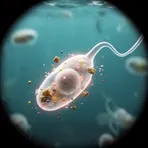
A tiny single-celled animal-like creature that swims with a tail-like part and absorbs food

A single-celled organism that moves using whiplike tails and sometimes causes disease in people
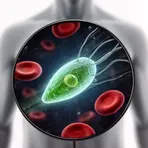
A single-cell creature that moves with tail-like parts and can cause disease in people

A one-celled organism that moves with whip-like tails and can cause disease in animals or people
Surface Forms
Morphology
zoomastigote = mastigote (opaque) = zoo + mastigote
Although 'zoo-' signals 'animal', the second element 'mastigote' is a technical combining form unfamiliar to typical learners, so the meaning is not derivable for an average B1 learner.
Etymology
Zoomastigote comes from Greek parts zoo- meaning 'animal' and -mastigote meaning 'whip', referring to the whip-like tail these cells use to swim. So a zoomastigote is a single-celled, animal-like organism that moves with a whip-like tail and does not act like a plant.

