
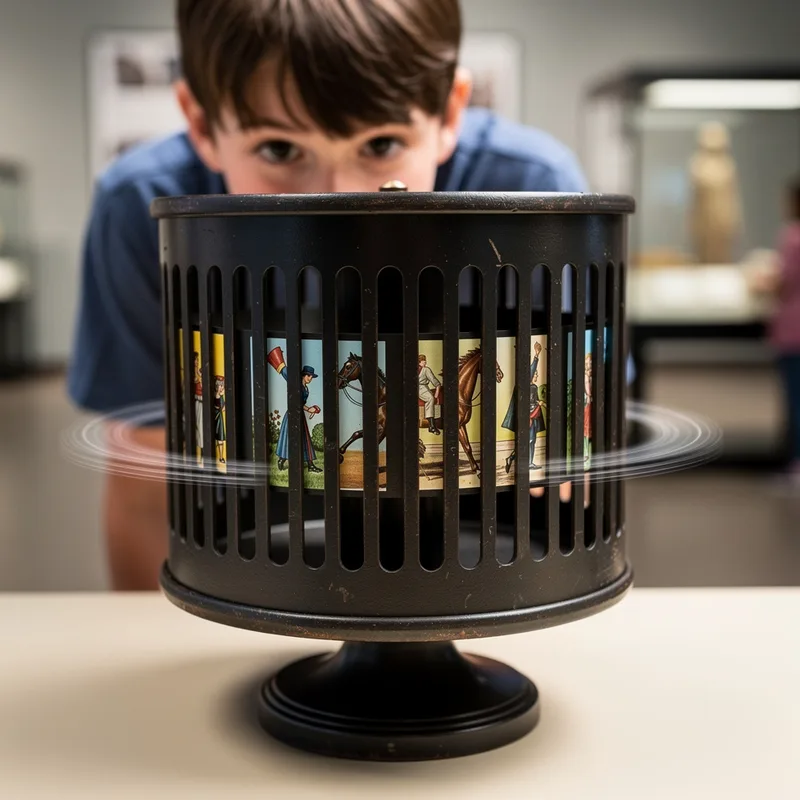
zoetrope
 1
9.9
1
9.9

- noun
- /ˈzoʊəˌtroʊp/
 :
zoótropo
:
zoótropo
- The Zoetrope demonstrates the persistence of vision, patent medicines addict children to morphine, and women are rallying for the vote.
Today we're talking about animation, zoetropes and flip books.
- Today we're talking about animation, zoetropes and flip books.
Examples
-
William George Horner constructed the first zoetrope in 1834, which was among the first devices to create an image of a moving picture (Freeman, 2005).
Academic text (2010) -
[zoetrope tinkling]
-
" It's called a zoetrope.
Fiction book (1993) -
Figure 1 depicts an illustration of a zoetrope and its operation.
Academic text (2010) -
Today we're talking about animation, zoetropes and flip books.
-
The persistence of vision phenomenon is easily understood by using a zoetrope.
Academic text (2010) -
Consider, however, a much earlier history of cinema: journalist E. V. Lucas's reminiscence of his childhood cinema experiences in an essay in the New York Times entitled "Cinema History." "The first cinema that most of us who are no longer young can remember was," he wrote in 1923, "called the zoetrope (or wheel of life).
Academic text (2017) -
Artwork currently on display includes Bruce Cannon's Ten Things I Can Count On, Arijana Kajfes' Genus Knoll, and Stewart Dickson's Three Dimensional Zoetrope.
Academic text (2001) -
The children watched the images move as the zoetrope spun around quickly.
-
In art class, we learned how to create simple animations using a zoetrope.
Synonyms
An early machine that projects pictures to show movement
Surface Forms
Morphology
Etymology
Zoetrope comes from Greek parts: zoo- meaning 'animal' or 'life', as in zoo, and -trope meaning 'turn'. So a zoetrope is a 'turning of life' and is a spinning drum that makes still pictures look like they move.