
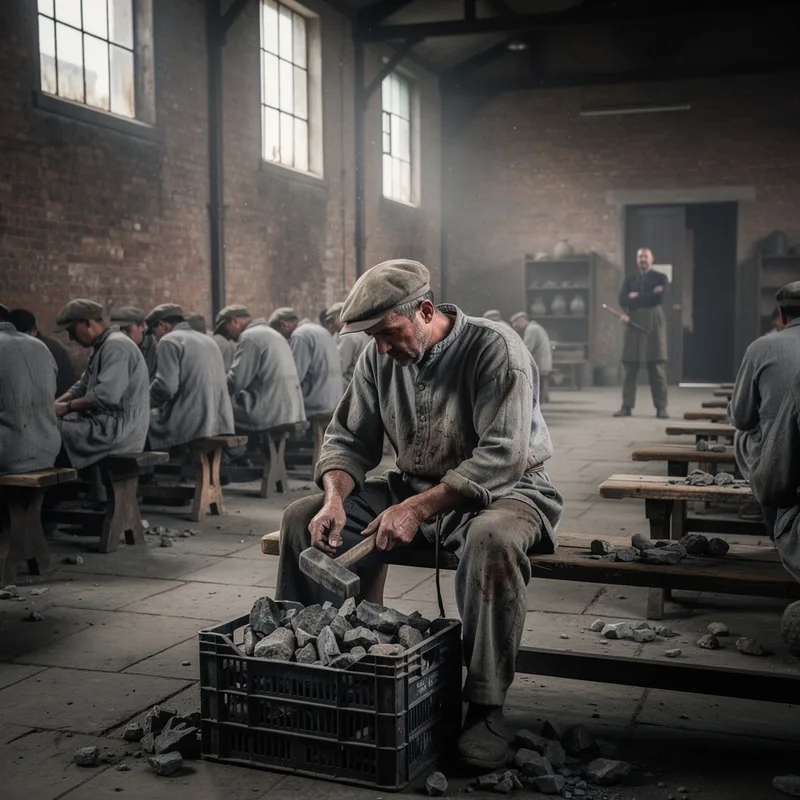
workhouse
 7
9.9
7
9.9

- noun
- /ˈwɜrkˌhaʊs/
- Archaic
- They got me down at the workhouse.
- a county workhouse
Loading YouTube…
Watch on YouTubeIn fact, they began to whip, compel, and coerce laborers in the workhouses of Ireland and Scotland and southern England.
- In fact, they began to whip, compel, and coerce laborers in the workhouses of Ireland and Scotland and southern England.
- Well, one of the last workhouse is to close.
- So then we had to move to a workhouse over in South London that was from West London, from West London, from the workhouse.
Examples
-
Oliver comes before the workhouse board, which consists of "eight or ten fat gentlemen."
Academic text (2005) -
Durbach shows convincingly that the workhouse diet was not always as uniformly bleak as Baxter or Raymer suggested.
Academic text (2017) -
And on the way back, I went by the workhouse, just to take a look.
-
Do you know the workhouse where the boy was born?
-
Some of you will perhaps be put into the workhouse.
-
She must have made her way to that workhouse and had her baby there.
-
lt is the sentence of the court that you be confined to the workhouse for 30 days or pay a fine of $50.
-
New guards replaced the old on the streets and at the doors of the workhouses.
Fiction book (1991) -
N1: More than 200 years ago, a young orphan named Oliver Twist was sent to a workhouse outside London, England.
Academic text (2010) -
In the 19th century, many poor families were forced to enter the workhouse to survive.
Synonyms


Surface Forms
Morphology
Etymology
Workhouse comes from simply joining work (meaning 'to do a job') and house (meaning 'a place to live'). It originally meant a place where poor people were given a home but had to do work, which is why today it names those old institutions where people were housed and put to work.