
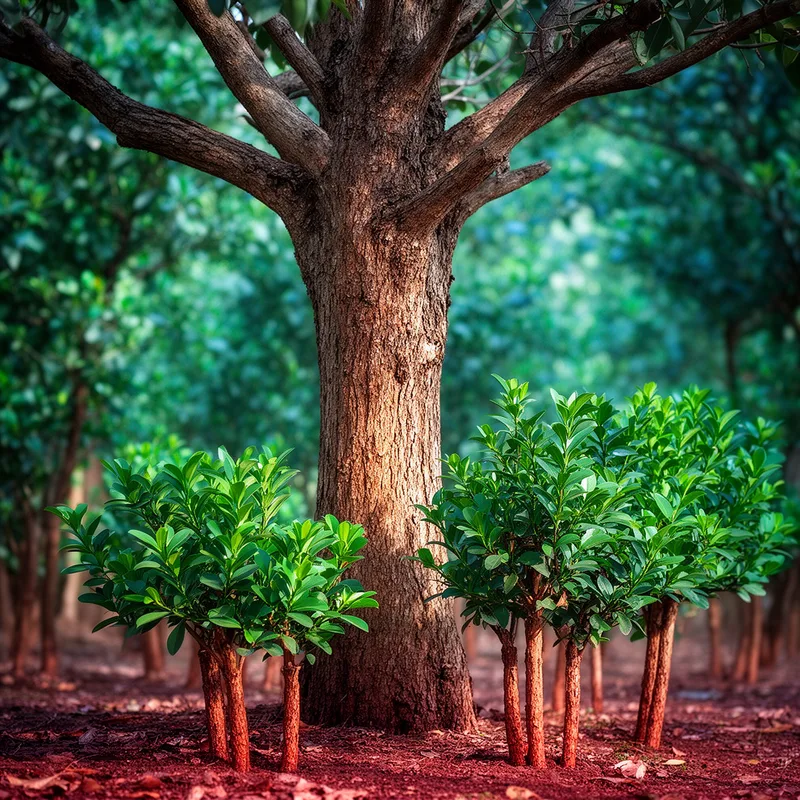
woody plant


 1
3.8
1
3.8
- noun
- /ˈwʊdi plænt/
- Specialized
- Many of the woody plants on the grounds of Boston's Arnold Arboretum are blooming earlier.
- cattails and woody plants
Examples
-
Deer often feed on woody plants during the winter months when other food sources are scarce.
-
Fire kills such woody plants as titi and inkberry, which otherwise tend to displace more fragile species.
Academic text (1991) -
Trees are tall woody plants that have leaves and one load bearing trunk.
-
Without regular fire, woody plants invaded the meadows, displacing the grass.
Academic text (2002) -
Common hackberry, groundsel tree, red maple, southern wax myrtle, and sweetbay are common woody plants.
Academic text (2010) -
What woody plants there are—willows, alders, and viburnums—are all less than fifteen feet tall.
Academic text (1992) -
Burning not only keeps woody plants from overrunning boggy areas, it also keeps invasive species from transforming the adjacent longleaf pine forests.
Academic text (2010) -
Topock Marsh, no longer swept by periodic floods, was clogged with cattails and woody plants until refuge biologists began restoring the marsh.
Academic text (2001) -
Residential land did not usually approach the vegetative biomass of forestland, but because of an increased density of woody plants and shrubs, it did contain more aboveground biomass per unit area than agricultural landscapes.
Academic text (2008) -
Many gardeners prefer woody plants like shrubs and trees for their durability and beauty.
Synonyms
A plant with hard woody stems like trees and shrubs
How Woody

Surface Forms
Morphology
The meaning is directly compositional: 'woody' describes having the qualities of wood and modifies 'plant', so a learner who knows both words can infer a plant with hard, lignified tissues. This adjective+noun combination follows a common, cross-linguistic pattern and requires no idiomatic knowledge.
Etymology
Woody plant comes from the simple picture of a plant that makes real wood in its stems and trunks. That's why it means 'a plant with hard, long‑lasting stems', like trees and shrubs.