
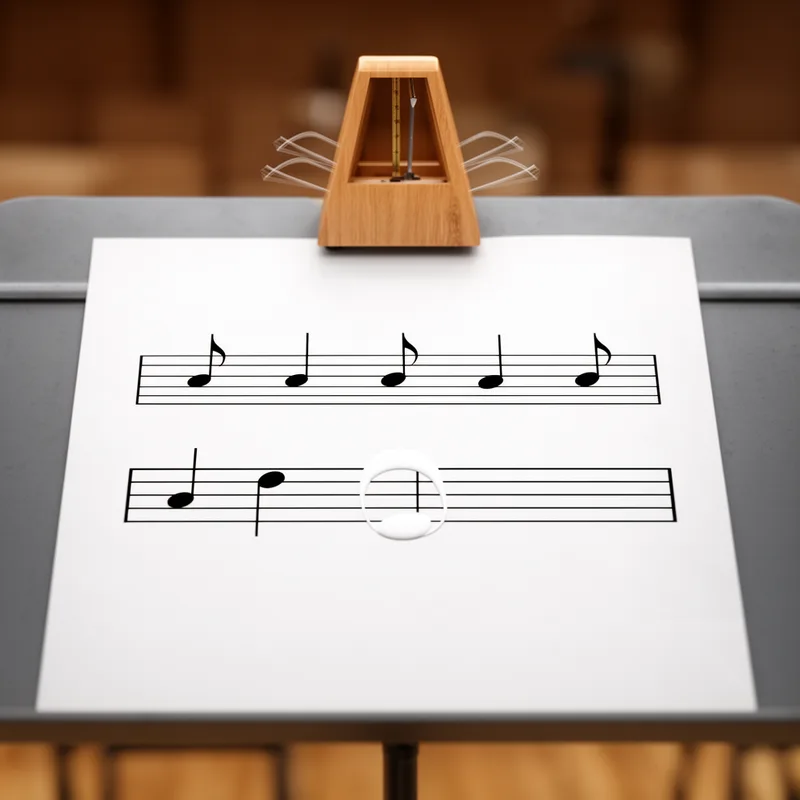
whole note
 1
4.2
1
4.2

- noun
- /hoʊl noʊt/
- Specialized
- One student or teacher can play the whole notes of a scale while another student freely improvises with the notes that go with each scale note.
- half and whole notes
- quarter and whole notes
Examples
-
Some instrument groups played whole notes, while others played eighth notes.
Blog text (11) -
Figure 7: Invite students to place the whole notes onto the staff.
Academic text (2012) -
In Figure 5, a bass line of whole notes is provided with the basic chord changes written below it.
Academic text (1997) -
The first line of music began with a whole note followed by a whole rest, during which I dutifully counted to four.
Academic text (2006) -
The composer decided to start the piece with a whole note to establish a calm rhythm.
-
In music class, the teacher explained that a whole note lasts for four beats in common time.
-
To practice, the students clapped to the beat of a whole note before adding the other rhythms.
Synonyms

A musical note held for four beats in common time
Antonyms


- Specialized
1
4.8
A musical note that lasts half a beat and is written with a solid head, stem, and one flag
How Short
- UK

- Specialized
- Specialized

 1
5.8
1
5.8
- Specialized
1
4.8
- Specialized
1
3.9
- Specialized
1
3.6
- Specialized
1
4.2
Surface Forms
Morphology
The meaning 'a note occupying the whole/entire value' is directly derived from combining 'whole' (entire, complete) with 'note' (musical sound/notation); a learner who knows both words can infer it denotes a long or full-length note. This compositional pattern (a modifier indicating 'entire' + musical 'note') is conceptually common across languages and in musical terminology, so it is readily understandable to a B1 learner.
Etymology
Whole note comes from the idea that the word whole means it fills a whole group of beats in a bar, so you hold the note for the entire set of beats. That's why a whole note lasts 'four beats'.