

wheel horse
- noun
- Archaic
- In the old carriage teams, the wheel horse bore much of the weight during sharp turns.
Examples
-
The wheel horse is essential for pulling heavy loads.
-
Farmers often chose their strongest animals to serve as the wheel horse in a team.
-
The sturdy wheel horse was vital for steadying the wagon on rough roads.
-
Two wheel horses were used to pull the wagon.
-
The farmer relied on his trusty wheel horse to pull the heavy wagon through the muddy fields.
-
The wheel horse was vital to the team, providing the strength needed to navigate the steep hills.
-
At the back of the carriage, the wheel horse kept pace with the rest of the team as they trotted along the country road.
Synonyms
 1
3.8
1
3.8

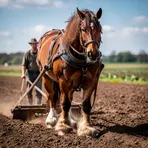
A large strong horse that pulls heavy loads like a cart or plow
 1
9.9
1
9.9
A horse hitched nearest the wheels to help pull a cart or wagon
 1
3.4
1
3.4
A strong horse used to pull heavy loads on a farm
 1
3.9
1
3.9
An animal like a horse or ox that pulls heavy loads on a farm


 1
3.2
1
3.2
A strong horse used to pull carts or heavy loads
 1
7.7
1
7.7
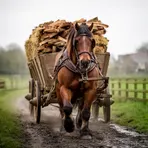
A large strong animal that pulls heavy carts or wagons
 1
9.6
1
9.6
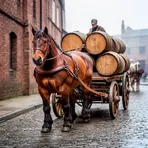
A large strong horse used to pull heavy carts or wagons

A horse trained to pull a cart or carriage

A large strong horse that pulls heavy carts or wagons
Surface Forms
Morphology
The compound meaning — a horse associated with the wheels or positioned nearest the wheels of a vehicle — is directly derivable from combining 'wheel' (the rotating part of a vehicle) with 'horse' (the animal). This follows a common English noun-noun composition pattern, so even if the term is somewhat specialized or rare, a B1 learner who knows both constituent words can infer the intended meaning.
Etymology
Wheel horse comes from teams of working animals: a strong horse was hitched closest to the cart wheel, so it took the heavy pull and steadying work in sharp turns. That's why the name came to mean 'a steady, reliable worker'.