
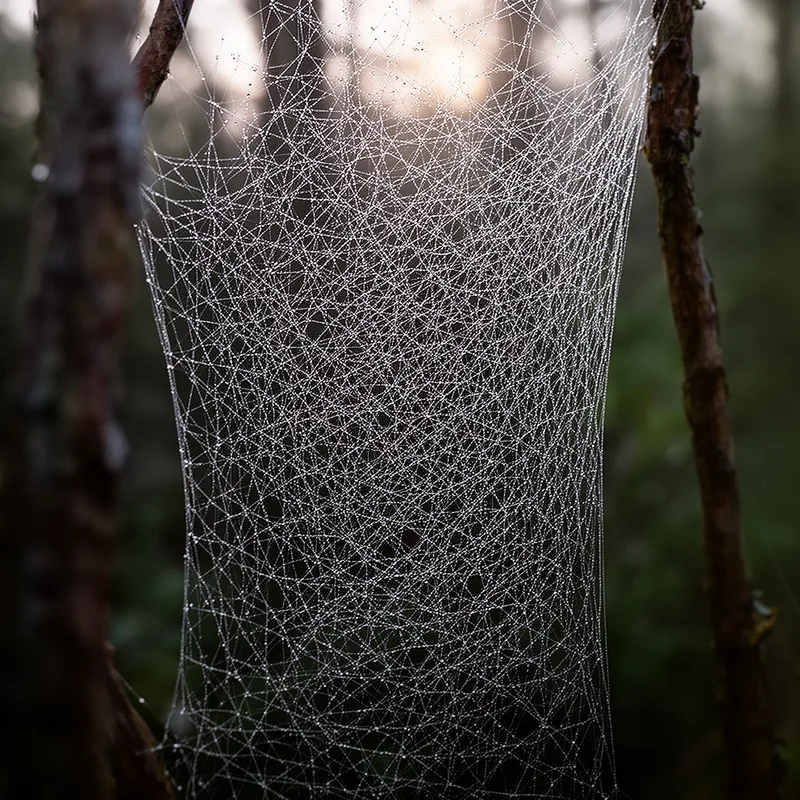
weblike
- adjective
- /ˈwɛbˌlaɪk/
- The only red in the otherwise dirty gray walls was thin, weblike veins, and there were no gates, glowing or otherwise.
Examples
-
In the garden, the weblike pattern of the vines created a beautiful natural tapestry.
-
A few white, weblike hairs were carried in the air behind him (214).
Academic text (1997) -
She wonders when it was that her arms started to wrinkle, and has her face always seemed this weblike?
Fiction book (1995) -
The difficulties the state leaders had in establishing control also had to do with what Joel Migdal has described as the weblike nature of third-world societies, which consists of "co-mingled, multiple sets of beliefs and memories."
Academic text (2000) -
Those gels consist of weblike filamentary networks of biopolymer embedded in the ambient extracellular or intracellular solution.
Academic text (2005) -
For instance, to enable students to better understand the infinite, nonlinear, netlike aspects of the internet and the weblike aspects of the World Wide Web, which include the idea of hyperlinks, students could be presented with a diagram of one net subject that has been "surfing" or they may construct their own diagram as they pursue a subject of interest.
Academic text (1997) -
The spider spun a weblike structure that resembled a delicate lacework.
-
The architect designed the building with weblike beams that allowed for open spaces and natural light.
Synonyms

 1
3.2
1
3.2

Made of thin cloth with small open patterns

Having many thin connected threads like a spider's web
Having many small open spaces between thin crossing lines

Material with thin threads and many small holes

Having thin lines that form a shape like a spider's web
A pattern of many connected lines like leaf veins
How Weblike


Surface Forms
Morphology
Etymology
Weblike comes from web meaning 'a woven net' and the ending -like meaning 'similar to'. Think of weave: a spider weaves threads into a net, so weblike means 'having a structure like a web'.