
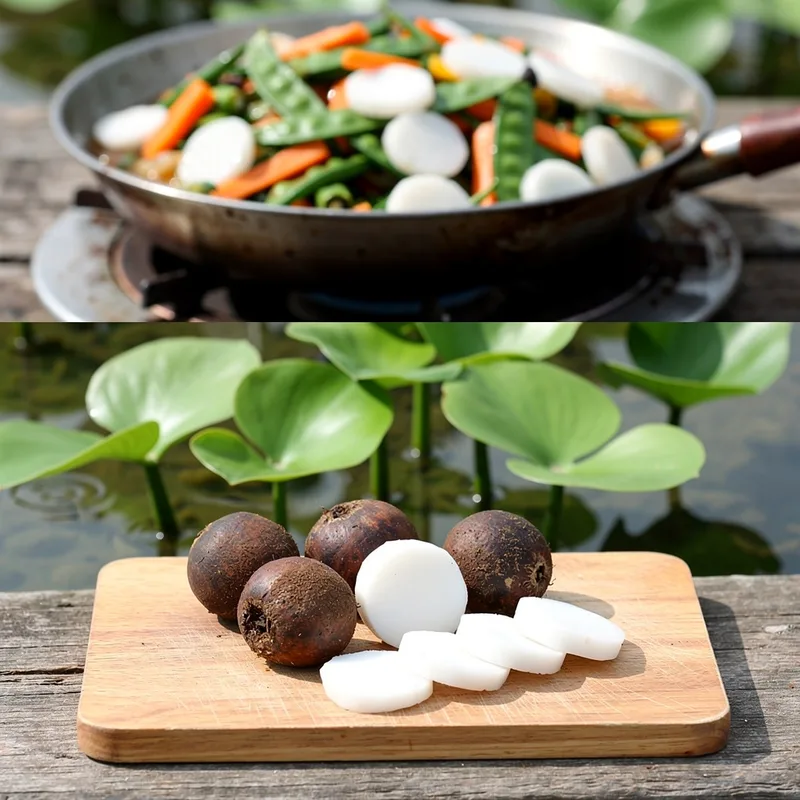
water chestnut
 2
3.0
2
3.0

- noun
- /ˈwɔːtər ˈʧɛstnət/
- They contained foods for enjoyment, such as dried venison, beef, and duck, and foods that served medicinal purposes, including soybean seeds and water chestnuts.
- sliced water chestnuts
- water chestnuts, drained
- a cup of water chestnuts
Examples
-
The recipe calls for chopped water chestnuts to add a crunchy texture to the spring rolls.
-
Now she's got Hoot slicing peppers, bok choy, and water chestnuts for stir fry in the kitchen.
Fiction book (1994) -
Would you like a water chestnut?
-
Where are the water chestnuts?
-
Who ate all the water chestnuts?
-
I'd love a water chestnut.
-
A can of Chung King water chestnuts is opened.
Fiction book (1993) -
You can add water chestnuts to stir-fry dishes for extra crunch.
-
In Asian cuisine, water chestnuts are often used in salads and as garnish.
Synonyms

A water plant with spiky four-part nuts that people eat

A water plant with hard spiny fruit that people eat
A water plant from Asia with edible seeds and spiky fruit with two sharp points
A water plant that produces round crunchy tubers called water chestnuts

A water plant with small crunchy bulbs eaten in Chinese cooking
Surface Forms
Morphology
water + chestnut
The meaning is directly derivable from combining 'water' (aquatic) with 'chestnut' (an edible nut/tree) to signal a nutlike edible plant that grows in water; a B1 learner who knows both words would readily infer an aquatic, edible ingredient. Although botanically it is not a true chestnut, the naming is clearly compositional and similar compounding patterns exist in many languages, so the sense is immediately accessible.
Etymology
Water chestnut may come from people comparing the plant's hard, round edible part to a chestnut that grows in water. So, while it is 'not a true chestnut', the name helps you remember a crunchy, nut-like piece from a water plant used in cooking.