
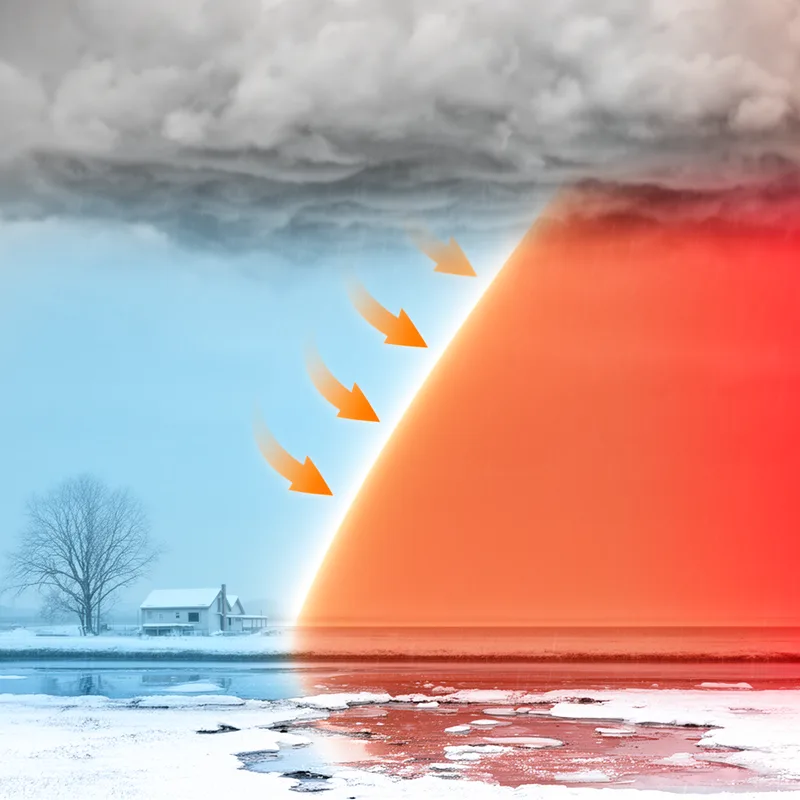
warm front
 1
3.7
1
3.7

- noun
- /wɔrm frʌnt/
- Specialized
- As the warm front approaches, you can expect an increase in humidity and a rise in temperature.
- cold and warm front
Loading YouTube…
Watch on YouTubeAnd then like cold, what happens at a cold front meets a hot front or a warm front and it discharges, begins discharging lightning, starts discharging plasmas, right.
- And then like cold, what happens at a cold front meets a hot front or a warm front and it discharges, begins discharging lightning, starts discharging plasmas, right.
Examples
-
Looks like the formation of a warm front cutting into central Ohio, which could mean a higher frequency of showers.
Blog text (15) -
On Monday, we'll see more 50s, but rain is looking likely with a warm front and then a cold front.
Blog text (34) -
Tomorrow, a cold front coming down from Canada and a warm front coming up from the Gulf could collide and cause some precipitation.
-
Tomorrow, the leading edge of some much warmer air located in the middle of the country is going to generate some clouds, but showers associated with this warm front should occur across northern portions of New York State and in New England (well to the north of the Tri-State Area).
Blog text (3) -
The warm front is bringing milder temperatures and clear skies to the area.
-
Forecasters predict that the warm front will lead to pleasant weather throughout the weekend.
Synonyms
 70
5.1
70
5.1
The line where two types of air meet and change the weather
Antonyms
How Cold

Surface Forms
Morphology
The noun phrase is a straightforward adjective + noun composition: 'warm' (higher temperature) modifying 'front' (a meteorological boundary), so the combined meaning of a boundary of warmer air is directly derivable. This compositional pattern is common cross-linguistically (e.g. Spanish 'frente cálido', French 'front chaud') and would be predictable to a B1 learner who knows both constituents.
Etymology
Warm front uses warm and front to paint a simple picture: it is the place where warm air moves into colder air, like a warm wave pushing into a cold area. That's why it means a moving area of 'warmer air' that brings 'warmer weather' and often rain.