
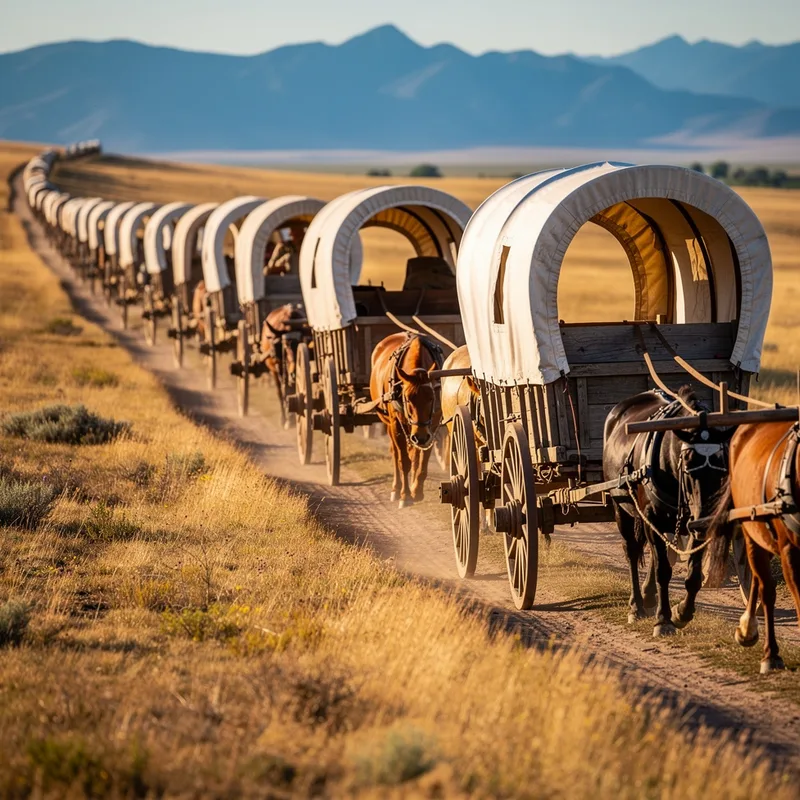
wagon train
 7
3.8
7
3.8

- noun
- /ˈwæɡən treɪn/
- US
- The wagon train moved slowly across the prairie, providing safety in numbers.
- wagon trains heading west
- attack a wagon train
- join a wagon train
Loading YouTube…
Watch on YouTubeI mean, I'd like to have just had that wagon train go to Canada by then, you know, and just stayed with it.
- I mean, I'd like to have just had that wagon train go to Canada by then, you know, and just stayed with it.
Examples
-
Once I saw a white woman who was part of a wagon train coming through the fort.
Fiction book (1992) -
A lot of wagon trains were pushing west to Oregon or California.
Fiction book (2002) -
It's just about where the wagon train would be.
-
We join the wagon train.
-
After my wife died we join the wagon train heading west.
-
The day that the wagon train left from Missouri.
-
There they would join one of the many wagon trains heading to California, where they would homestead and make their fortune.
Fiction book (2001) -
A few months after first receiving word that she was free, Sarah Jane boarded a wagon train headed for Arkansas.
Academic text (2008) -
Mojave warriors attacked the first immigrant wagon train that took the new federal route from Albuquerque to the Pacific Coast.
Academic text (1998) -
It's influenced by the pioneering spirit of our foremothers who went in wagon trains across the wilderness and they settled in homesteads.
Synonyms
 110
1.3
110
1.3
A line of people, animals, or vehicles moving together
 84
4.1
84
4.1
A group of people who travel together with animals or vehicles for safety across a desert
How Many

Surface Forms
Morphology
The meaning is directly compositional: 'wagon' (a cart for transporting goods) combined with 'train' (a procession or line) yields a procession/line of wagons. This noun‑noun combination follows a common, cross‑linguistic pattern, so a B1 learner who knows both constituents will readily infer the MWE meaning.
Etymology
Wagon train comes from the image of settlers linking many wagons into a long train as they crossed the plains so they could help and protect each other on a long journey. That's why it means 'a line of wagons traveling together for mutual support and protection'.