
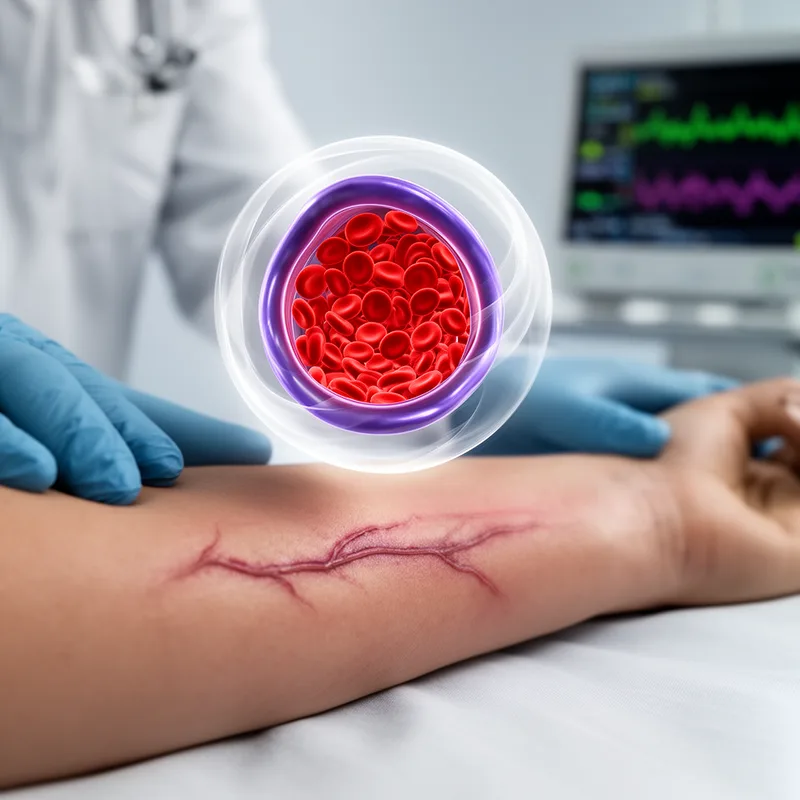
venous pressure


 1
5.1
1
5.1
- noun
- /ˈviːnəs ˈprɛʃər/
- Specialized
- Peri-op monitoring is also vital with arterial and central venous pressure lines being used in all patients.
- jugular venous pressure
- central venous pressure
- venous pressure monitoring
Examples
-
A central line was placed to improve IV access and to monitor his central venous pressure.
Academic text (2007) -
Implementation of protocolized haemodynamic management strategies aiming to achieve central venous pressures of 8-12 mm Hg rapidly, and more restricted fluid loading later on, are recommended.
Academic text (2016) -
They'll do a central venous pressure.
-
Initial central venous pressures were available only for patients in whom central monitors were placed (46%).
Academic text (1998) -
Some clinicians opt to place a central line to monitor central venous pressures and guide fluid replacement.
Academic text (2007) -
Hypovolemic symptoms may also be present, which may include hypotension, increased heart rate, and altered cardiac output and central venous pressure.
Academic text (2004) -
When cardiac function is impaired, the relation between central venous pressure and cardiac preload is altered and not reliable.
Academic text (2003) -
Thirty-five major head and neck surgical patients were randomly selected for examination with the placement of a central venous pressure monitor.
Academic text (1998) -
Assessment of cardiac output, arterial and central venous pressure, and pulmonary artery pressure enables calculation of systemic and pulmonary vascular resistance.
Academic text (2003) -
The doctor explained that monitoring venous pressure can help assess fluid status in patients.
Surface Forms
Morphology
The meaning 'pressure exerted by blood on the walls of the veins' is directly and compositionally derived from 'venous' (related to veins) + 'pressure' (force), following a simple adjective + noun pattern. This medical/scientific construction is cross-linguistically regular and would be understandable to a B1 learner who already knows both constituent words.
Etymology
Venous pressure comes from a simple picture: veins are the thin tubes that carry blood back to the heart and pressure is how hard the blood pushes on their walls. So, 'venous pressure' means the force of the moving blood against the vein walls, and doctors check it to see how well the heart is working.