
vegetable wax
- noun
- /ˈvɛdʒtəbl wæks/
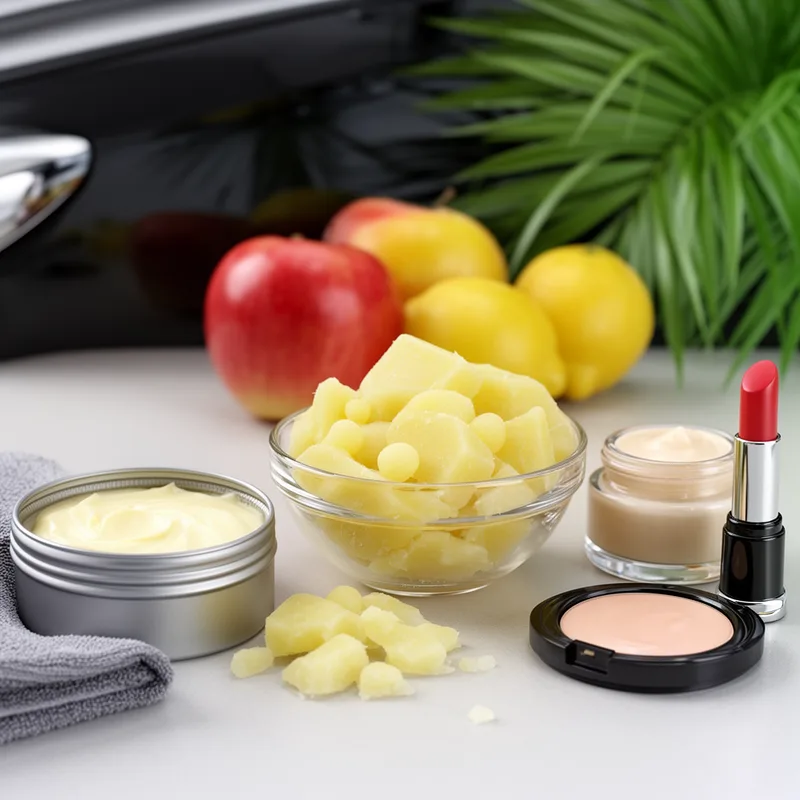
- Carnauba is a type of vegetable wax commonly used in car polishes and cosmetics.
Examples
-
Some candles are made with vegetable wax instead of paraffin for a cleaner burn.
-
The natural coating on many fruits is actually a thin layer of vegetable wax.
-
I bought a jar of vegetable wax for my candles.
-
Many cosmetics contain vegetable wax as a thickening agent.
-
Carnauba is a type of vegetable wax commonly used in car polishes and cosmetics.
-
Some candles are made with vegetable wax instead of paraffin for a cleaner burn.
-
Many cosmetics contain vegetable wax as a thickening agent.
Synonyms

 187
2.8
187
2.8

A solid natural material that bees make, used to make candles and polish things

A hard yellowish wax from a palm used to make surfaces shiny and protect them

A hard plant wax from the leaves of a shrub used in cosmetics, food, and polishes
A yellowish wax made from sumac berries and used for candles and polish

A natural wax from plantain leaves that gives a shiny, water resistant coating

A green, fragrant material made from the bayberry plant used to make candles

A waxy fat from plants like bayberry used for candles and soap
Surface Forms
Morphology
vegetable + wax
The meaning 'a waxy substance derived from plants' is directly and transparently composed from 'vegetable' (plant-derived) + 'wax' (a solid used for polish), so a learner who knows both words can reliably infer the MWE. The noun–noun compounding pattern is a standard, cross-linguistic way to form descriptive substances (e.g., Spanish 'cera vegetal', French 'cire végétale'), which further supports immediate comprehensibility at the B1 level.
Etymology
Vegetable wax is the wax that comes from plants, with vegetable meaning 'from plants'. Imagine people scraping a shiny layer from palm leaves or fruit skins, for example carnauba, to make polish, candles, or skin creams, and so the name means 'a wax made from plants'.