
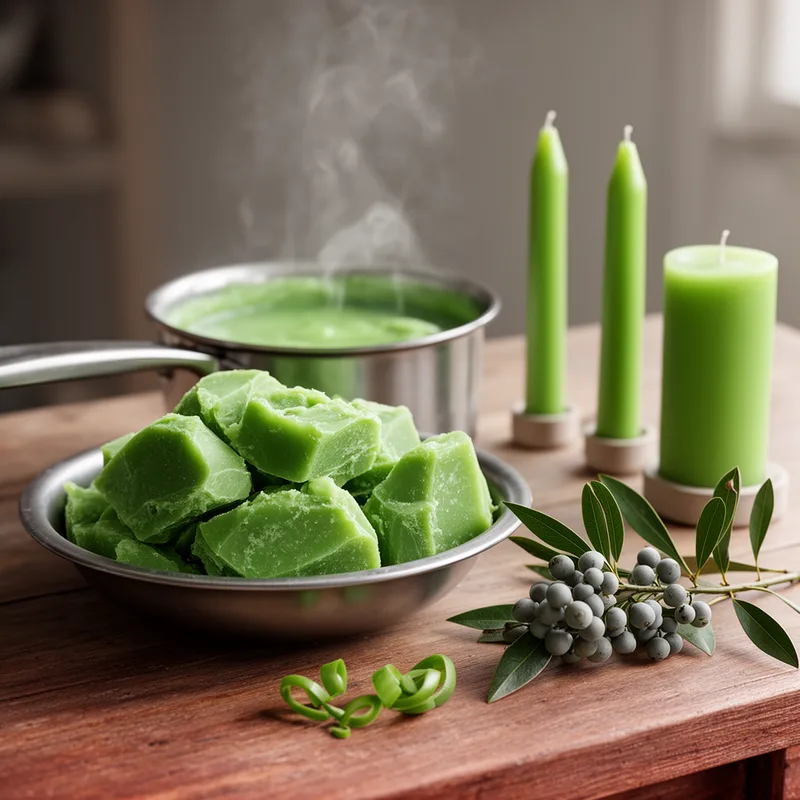
bayberry wax
- noun
- /ˈbeɪˌbɛri wæks/
- US
- Historically, colonial Americans used bayberry wax to produce cleaner-burning candles than tallow.
Examples
-
These handmade candles are made from natural bayberry wax and have a subtle, earthy scent.
-
It takes many berries to produce even a small amount of bayberry wax for crafts or candle-making.
-
I bought some bayberry wax for my candle-making project.
-
The bayberry wax has a lovely scent.
-
Colonial Americans famously used bayberry wax to create fragrant, clean-burning candles for their homes.
-
To make traditional candles, crafters often rely on bayberry wax due to its pleasant aroma and natural properties.
-
For my next candle-making endeavor, I want to purchase bayberry wax because it gives a lovely scent to the finished product.
Synonyms

 187
2.8
187
2.8

A solid natural material that bees make, used to make candles and polish things

A green scented wax from bayberry berries used for making candles

A waxy fat from plants like bayberry used for candles and soap

A firm, oily material from plants used in polishes and cosmetics
Surface Forms
Morphology
The meaning 'a wax obtained from the bayberry plant' is directly and compositionally derivable from 'bayberry' (the shrub with wax-coated berries) + 'wax' (a solid material), indicating a source-material relation. This follows a common noun+noun compounding pattern found across languages, so a B1 learner who knows the constituents can reasonably infer the MWE's meaning.
Etymology
The noun bayberry wax comes from the berries of the bayberry bush. People boiled many berries to make a small, scented wax for 'candles', so the name now means the green, scented wax used to make candles.