

ultraviolet light
 10
4.0
10
4.0

- noun
- /ˌʌltrəˈvaɪəlɪt laɪt/
- Specialized
- Exposure to ultraviolet light from the sun can lead to sunburn and skin damage.
- ultraviolet light irradiation
- ultraviolet light absorbed
- far ultraviolet light
Loading YouTube…
Watch on YouTubeFor example, ultraviolet light from the sun strikes the surface of Mars.
- For example, ultraviolet light from the sun strikes the surface of Mars.
- Fun fact, humans can't see ultraviolet light, but some other animals can.
- This ozone layer then absorbs much of the sun's ultraviolet light.
- Now, UVC is high frequency ultraviolet light.
- So X-rays are on the same electromagnetic field, electromagnetic wave continuum, ultraviolet light is on the same.
- So it is not been degraded by ultraviolet light in a lifetime of toxins and chemicals, pristine human DNA.
- OK, loosely speaking and down at the other end of the spectrum, the short wavelength light is more of the blue and green and so-called ultraviolet light.
Examples
-
The next step is to destroy the egg nucleus with ultraviolet light so that none of its genetic makeup remains.
-
For example, ultraviolet light from the sun strikes the surface of Mars.
-
And that means that they pass ultraviolet light just fine.
-
After he did that, he turned out the lights and put on an ultraviolet light.
-
This photograph was taken using ultraviolet light.
-
Fun fact, humans can't see ultraviolet light, but some other animals can.
-
These are made to block ultraviolet light from getting into a photopolymer tank.
-
Crab shells, however, also reflect ultraviolet light, which the animals can probably detect.
Academic text (2004) -
Water will be treated with ultraviolet light and hydrogen peroxide to control odor and taste.
Academic text (2007) -
One of the primary ways in which plastic weathers is that ultraviolet light breaks down its polymer chains and fades its colour.
Synonyms
 14
5.1
14
5.1
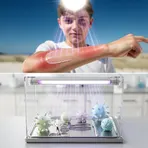
Invisible light with waves shorter than visible light that can cause sunburn
 5
3.9
5
3.9
A strong invisible light from the sun that can damage skin and kill germs
 4
4.1
4
4.1
Invisible light from the sun that can burn skin
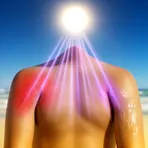
Invisible light that can burn or damage skin

Invisible light beyond the violet end of visible light

A type of light, often ultraviolet, that can cause chemical changes
Surface Forms
Morphology
The meaning is directly compositional: 'ultraviolet' names a region beyond violet in the spectrum and 'light' names electromagnetic radiation, so the phrase straightforwardly denotes that portion of light. This is a common scientific compound with equivalent constructions in many languages, making it predictable for a learner who knows the constituents.
Etymology
Ultraviolet light comes from its parts ultra (meaning 'beyond') and violet (the deep purple color at the end of the rainbow). So the name shows it is light just beyond violet that our eyes cannot see but that can cause sunburn and kill germs.