

turbid
 1
8.1
1
8.1

- adjective
- /ˈtɜrbɪd/
- The river was so turbid after the storm that we couldn't see the bottom.
- turbid water
- extremely turbid
- turbid inlet
Examples
-
The lagoons have firm sandy edges, but are mostly muddy in their main regions; waters are turbid.
Academic text (1996) -
Aerial view of the turbid Cape Fear River joining the blackwater Black River on the North Carolina coastal plain.
Academic text (2002) -
So you might still need to filter it if it's turbid, but as one step that's actually pretty effective.
-
In upper Cook Inlet, the waters are extremely turbid to the point of being nearly opaque.
Academic text (2000) -
High filtration capacity allows large volumes of turbid water to be filtered without using extra capsules.
Academic text (1998) -
Alone, gazing at the turbid, turbulent waters, he stood shrouded in thought.
Fiction book (1994) -
Siltation has made the water more turbid, lowering oxygen levels drastically and reducing the number of microscopic plants and animals.
Academic text (1990) -
The turbid water invades the banks of the canals; the bridges, their stone slabs, made insidiously slippery.
Fiction book (1997) -
The relatively fresh turbid upper Cook Inlet outflow meets and mixes with incoming ACC water in the central inlet.
Academic text (2000) -
The swimming pool was turbid because of the fallen leaves and dirt.
Synonyms
 73
1.1
73
1.1
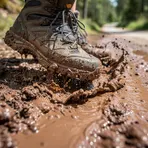
Covered in mud and hard to walk on
 23
3.7
23
3.7
A liquid that is dark and cloudy because it has dirt in it
 9
2.3
9
2.3
Liquid that is not clear and has small particles
 1
4.9
1
4.9
Containing fine, soft mud left by water

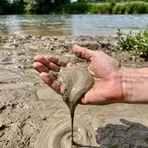
Water or other liquid that has mud mixed into it

Water that is cloudy and moving roughly
Antonyms

How Turbid

Surface Forms
Etymology
The word turbid comes from the old Latin turbidus, from turba which means 'crowd' or 'confusion', and it is related to disturb and turbulent. So a turbid liquid is 'stirred up' and cloudy because small bits are mixed into it.