
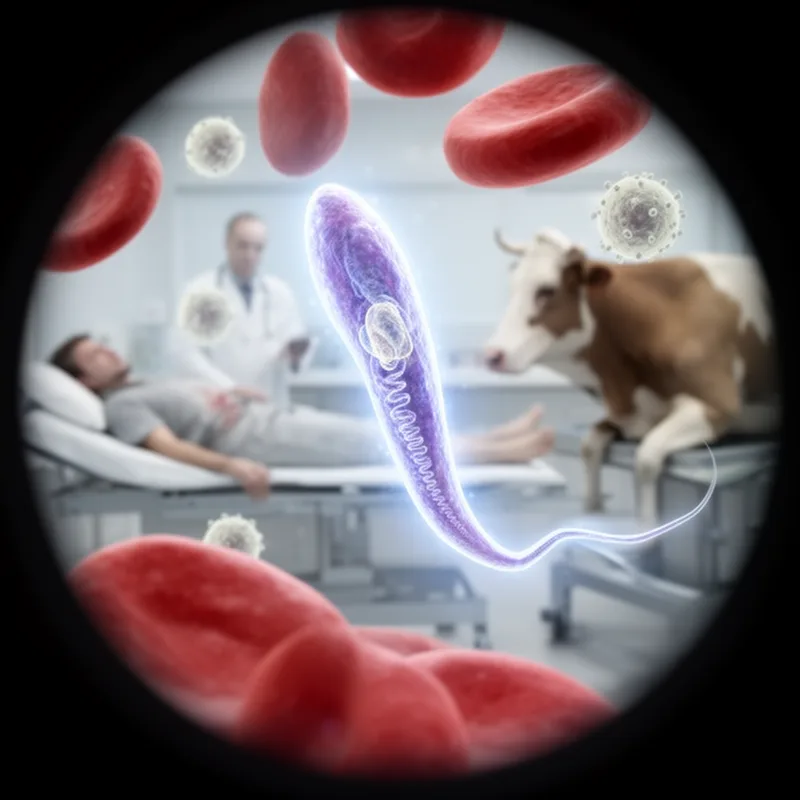
trypanosome


 1
9.9
- noun
- /traɪˈpænəˌsoʊm/
- Specialized
- And these flies will bite people and they will inject these parasites, these trypanosomes into these humans who would then start to get sick.
- trypanosome cruzi
Examples
-
The three-month placebo controlled by an African trypanosome parasite, translational medicine relevant to emergency.
Blog text (25) -
The ability of cattle to maintain human infective trypanosomes for long periods poses a serious threat to the health of rural people at a time when increased use of cattle is desperately needed to intensify rural productivity.
Academic text (2001) -
They also vary their surface protein, so here is a an enhanced photo of a trypanosome with some red blood cells behind it.
-
Inactivated the trypanosomes that two years and four months led us to a better understanding than healthy study.
Blog text (25) -
Despite only 7 cases of vector transmission to humans reported in the United States (3, 4), T. cruzi trypanosomes are present in >20 wildlife species.
Academic text (2012) -
Chagas disease is a vector-borne disease caused by Trypanosoma cruzi trypanosomes.
Academic text (2012) -
Nagana is caused by three species of trypanosomes, unicellular blood parasites that eventually reach the brain and nerve synapses, preventing coordinated body movement.
Academic text (1998) -
Although vector transmission of T. cruzi trypanosomes is a minimal risk, 9 of the 11 triatomine species in the United States are potential vectors (7, 7), and parasite transmission could increase because of climate change (7).
Academic text (2012) -
The most prevalent disease in bumblebees is caused by the trypanosome Crithidia bombi—a mobile protozoan closely related to the microorganism that causes human sleeping sickness.
Academic text (2003) -
In Africa, trypanosomes are spread by the tsetse fly and cause sleeping sickness.
Synonyms
 1
9.9
A tiny parasite that lives in the blood of people and animals and causes sleeping sickness or Chagas disease
Surface Forms
Morphology
trypanosome = trypanosoma (opaque) = trypano + soma
Formed from Greek scientific combining forms ('trypano-' + 'soma') that are technical and not meaningful to an average B1 learner.
Etymology
The word trypanosome comes from Greek parts trypano- ('to bore') and soma ('body'). Think of it as a 'borer-body', a tiny single-celled parasite that bores into the blood or body, which is why it causes diseases like sleeping sickness.