
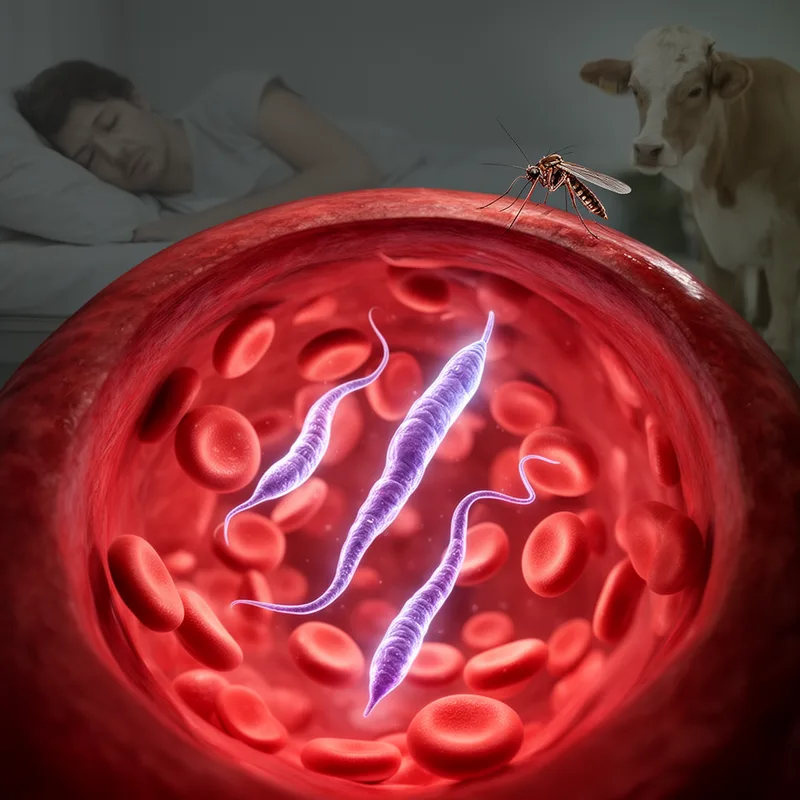
Trypanosoma


 1
9.9
- noun
- /traɪˌpænəˈsoʊmə/
- Specialized
- Chagas disease is caused by the protozoan parasite Trypanosoma cruzi, and insect members of the subfamily Triatominae are intermediate hosts.
- Trypanosoma cruzi
- Trypanosoma cruzi infection
Examples
-
Of triatomes sampled in that year in the capital (Tegucigalpa), 45% were infected with Trypanosoma cruzi.
Academic text (1993) -
Infections caused by Trypanosoma species can lead to serious health issues, especially in tropical regions.
-
Chagas disease is a vector-borne disease caused by Trypanosoma cruzi trypanosomes.
Academic text (2012) -
American trypanosomiasis or Chagas' disease is a chronic disease caused by the parasite Trypanosoma cruzi.
Academic text (1997) -
Benznidazole, a nitroimidazole derivative, has been recommended for the treatment of acute and congenital Trypanosoma cruzi infection (Chagas' disease).
Academic text (1997) -
Chagas disease is caused by the protozoan parasite Trypanosoma cruzi, which is transmitted by triatomine bugs.
-
Researchers are studying the effects of Trypanosoma brucei, the parasite responsible for African sleeping sickness.
Synonyms
 1
9.9
A tiny single-celled parasite that makes people and animals sick, for example sleeping sickness
 1
9.9
A thin surgical tool that makes a small hole in a membrane or a tiny one-celled parasite
Surface Forms
Etymology
Trypanosoma comes from old Greek parts trypano- 'borer' and -soma 'body'. So the name paints a picture of a 'boring body' — a tiny drill-like organism that lives in the body and can cause disease, which helps you remember this parasite and what it does.