
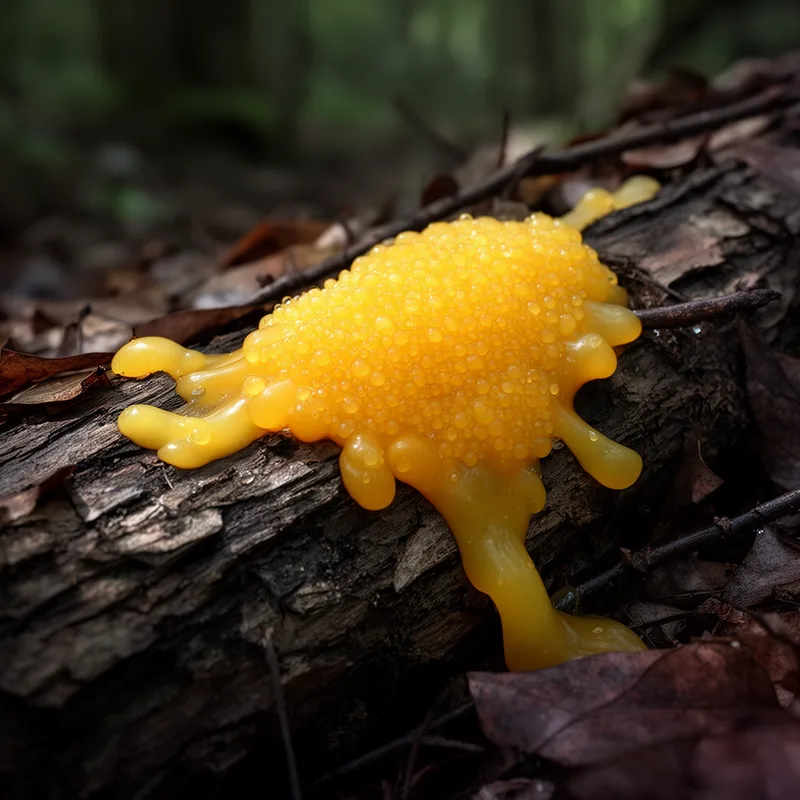
true slime mold
- noun
- /tru slaɪm moʊld/
- Specialized
- Unlike cellular slime molds, true slime mold forms a large, acellular mass called a plasmodium.
Examples
-
Researchers study true slime mold for insights into cell movement and differentiation.
-
True slime mold can be observed on decaying logs in humid forests.
-
The true slime mold can be found in damp, shady areas.
-
Did you know that true slime molds can move towards food sources?
-
True slime mold can often be found thriving on decaying wood in moist forest environments.
-
Scientists are fascinated by true slime mold because of its unique ability to move and feed similarly to amoebas.
-
True slime mold creates a large structure known as a plasmodium, which distinguishes it from other types of slime molds.
Synonyms
A soft organism that becomes one large cell with many nuclei and moves slowly

A soft slimy living thing like a fungus that grows in damp places
Surface Forms
Morphology
The phrase is compositionally transparent: 'true' simply modifies 'slime mold' to mean a genuine or proper slime mold, so a learner who knows the constituent words will infer it denotes a particular kind of slime mold. While there is technical taxonomic nuance (slime molds are protists rather than true fungi), that specialised distinction does not prevent a B1 learner from arriving at the basic, correct interpretation from the parts.
Etymology
True slime mold gets its name from the simple image of a single, slimy blob: slime that looks like a soft mold and moves together as one body. That's why 'true' shows these living things form a large moving mass instead of many separate cells.

