

triumphal arch


 1
6.1
1
6.1
- noun
- /traɪˈʌmfəl ɑːrk/
- Hundreds of triumphal arches were woven from palm fronds and flowers to mark the entrances to side streets and neighborhoods.
Loading YouTube…
Watch on YouTubeIt would have victory columns, triumphal arches, aqueducts, the whole panoply of classical civilization.
- It would have victory columns, triumphal arches, aqueducts, the whole panoply of classical civilization.
Examples
-
There was to be a triumphal arch, 108 feet long, under which General Howe was to walk after he disembarked from galleys at the wharf.
Fiction book (1994) -
And the ruins of a splendid triumphal arch symbolizing the empire in decay.
-
On the opposite side of the old town, there is the Augustus Arch, which is the oldest triumphal arch still surviving in northern Italy.
Blog text (20) -
The Romans enlarged the theatre, paved the Colonnaded Street, and built a triumphal arch over the entrance to the Siq.
Academic text (2008) -
The emperor Augustus was granted a triumphal arch in 19 B.C. for recovering the standards lost to the Parthians by General Crassus.
Academic text (2007) -
Antwerp's civic leaders chose to replace the old Gothic town hall on the Grote Markt with one built in the Renaissance style, just as they elected to build the Gate of St. George in the Doric style, a simulated triumphal arch like those of the Roman Empire.
Academic text (2011) -
The grand triumphal arch stood at the entrance of the city, celebrating its victory in the war.
-
Tourists flock to see the impressive triumphal arch that commemorates an important historical event.
-
Built to honor the heroes of the revolution, the triumphal arch is a symbol of national pride.
Synonyms
 160
3.4
160
3.4
A large structure that honours a famous person or important event
 41
3.5
41
3.5
A curved structure that spans an opening and supports weight
 16
4.0
16
4.0
A curved opening people walk through, often made of stone or brick
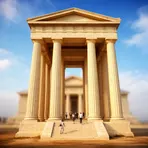
A large grand entrance to a temple or important building with tall columns
How Monumental

Surface Forms
Morphology
The meaning is directly compositional: 'triumphal' (relating to a victory celebration) modifies 'arch' (an arched structure), so a B1 learner who knows both words can infer it denotes an arch commemorating a triumph. This structure and lexical logic are common across many languages (e.g. French 'arc de triomphe'), making the concept predictable and transparent to learners.
Etymology
Triumphal arch comes from ancient Rome, where generals who won a battle held a parade called a triumph and marched under a large decorated arch. Because people passed through these arches to celebrate success, the building came to mean a special gate built to honour a 'victory'.