
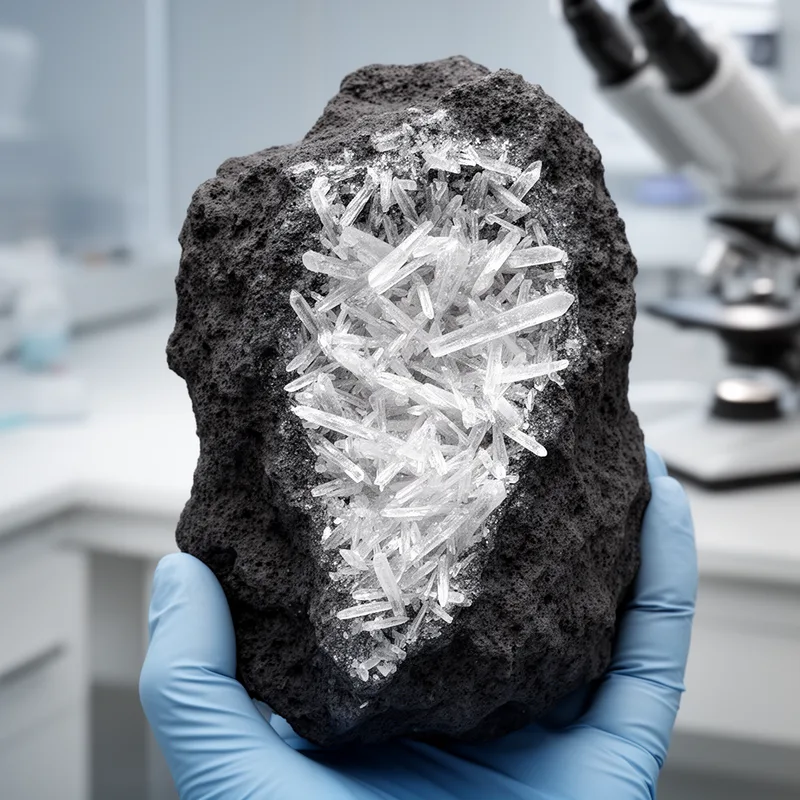
tridymite
- noun
- /ˈtrɪdɪˌmaɪt/
- Specialized
- Microscopic examination revealed that the thin, plate-like crystals were actually tridymite.
Examples
-
The presence of tridymite indicates the rock was formed at relatively low pressures and high temperatures.
-
The mineral tridymite is often found in volcanic rocks.
-
Geologists discovered a layer of tridymite in the volcanic rock samples from the region.
-
Some tridymites can form under high-temperature conditions.
-
Geologists discovered a layer of tridymite in the volcanic rock samples from the region.
-
Microscopic examination revealed that the thin, plate-like crystals were actually tridymite.
-
The presence of tridymite indicates the rock was formed at relatively low pressures and high temperatures.
Synonyms
 8
7.2

A common mineral in rocks and sand made from silicon and oxygen
Surface Forms
Morphology
tridymite = tri + dym + ite
The elements 'tri-' (three) and the mineral-forming suffix '-ite' are recognizable, but the central element is not a productive English morpheme and the precise technical meaning ('a specific silica polymorph') is not derivable by a B1 learner.
Etymology
The word tridymite comes from Greek parts tri- 'three' and didymos 'twin', a name inspired by the way its thin crystals often appear as twinned or grouped plates. So, thinking of 'three' and 'twin' helps you remember that tridymite is a form of silica that makes thin, plate-like crystals.