
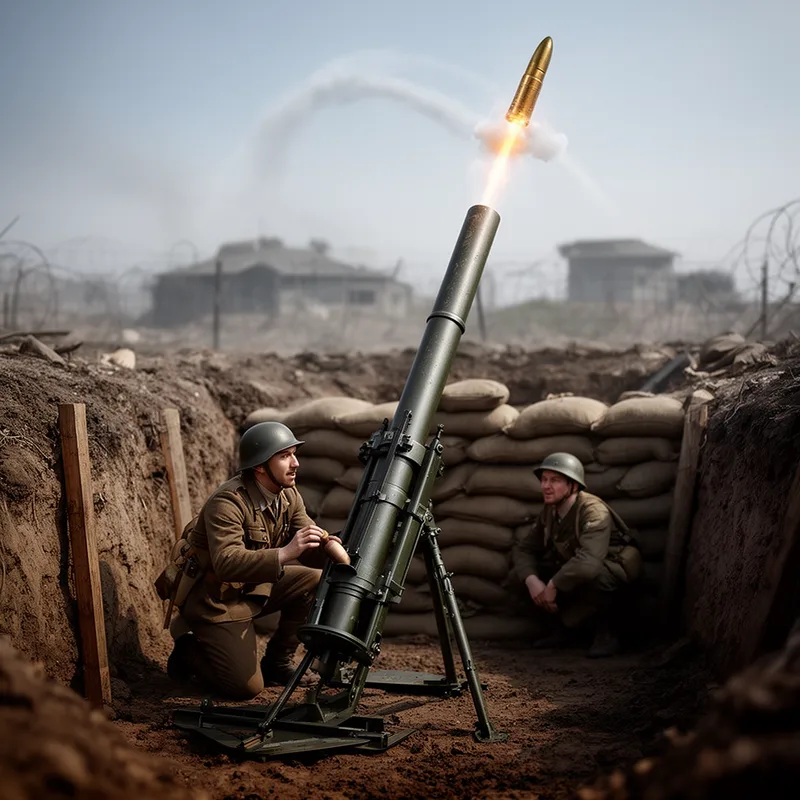
trench mortar
- noun
- /trɛnʧ ˈmɔrtər/
- Archaic
- Or as the First Circuit put it in a case decided a few years after Miller: "Another objection to this reading of Miller... is that according to it Congress would be prevented by the Second Amendment from regulating the possession or use by private persons of distinctly military arms, such as machine guns, trench mortars, anti-tank or anti-aircraft guns...."
- guns and trench mortars
- machine guns and trench mortars
Loading YouTube…
Watch on YouTubeThe technical answer to those problems were small trench mortars.
- The technical answer to those problems were small trench mortars.
Examples
-
The soldiers used a trench mortar to launch shells over the enemy's defenses.
-
I wish it was a trench mortar.
-
British Stokes trench mortars were much more common, and Chinese factories even produced homemade copies.
-
Haldane wrote: "Here men were pitted against individual enemies with similar weapons, trench mortars or rifles with telescopic sights, each with a small team helping him."
Academic text (1998) -
During World War I, trench mortars became essential for infantry units engaged in close combat.
-
The military conducted training exercises with a new type of trench mortar designed for better accuracy.
Synonyms
 76
7.5
76
7.5

A short gun that fires explosive shells at a high angle
 10
9.9
10
9.9
A large gun with a short barrel that fires shells high to hit nearby targets
Surface Forms
Morphology
The meaning is directly compositional: 'trench' specifies the location/context and 'mortar' names the weapon, so a learner who knows both words can infer it is a type of mortar used in trenches. Although technical specifics (short‑barrel, muzzle‑loading) are specialized, the core sense (a mortar for trench warfare) is transparently derivable and cross‑linguistically consistent.
Etymology
Trench mortar comes from World War I and the word mortar, a short, bowl-like launcher used near trenches. The weapon was a short, stout tube that 'threw' explosive shells in a high arc into enemy trenches, so the name connects its shape and its use.