
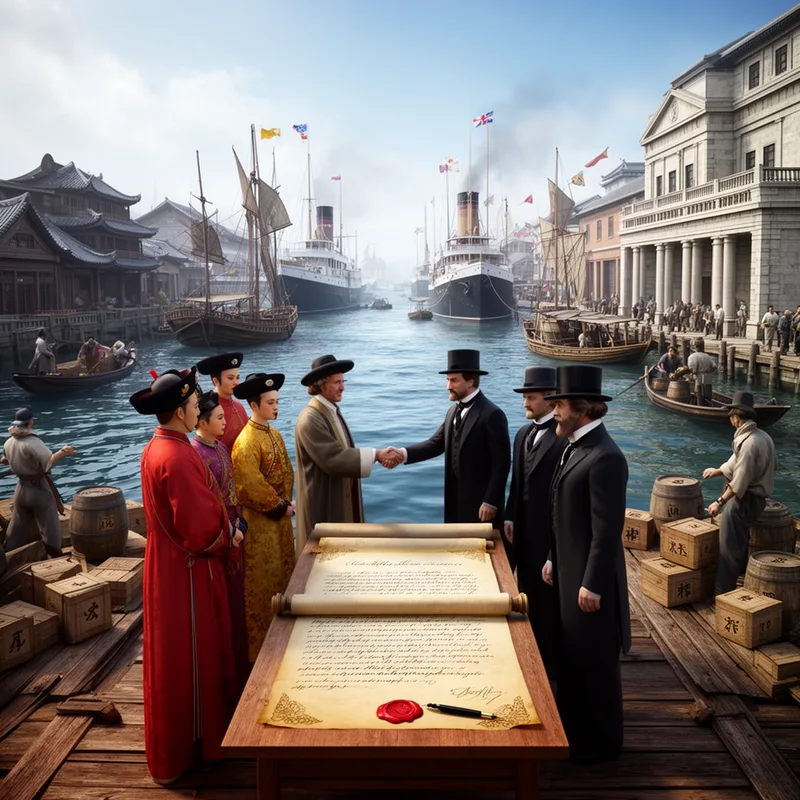
treaty port
- noun
- Archaic
- The southwestern province of Yunnan, where He Liyi grew up, was thousands of miles from the colonial treaty ports like Shanghai.
Examples
-
Xiamen is one of the original five treaty ports negotiated with China's imperial court.
-
After the British victories in the Opium Wars, Shanghai was designated as a foreign "treaty port" and concession.
Academic text (2008) -
He went from one treaty-port city to another.
Fiction book (1996) -
Unilateral concessions forced on the Chinese, such as extraterritoriality and foreign settlements in the treaty ports, are still perceived as a humiliating loss of sovereignty.
Academic text (1999) -
The houses built when Shanghai was a treaty port were huddled into narrow streets and squeezed around dainty courtyards.
-
After the British victories in the Opium Wars, Shanghai was designated as a foreign treaty port and concession.
Surface Forms
Morphology
The compound is compositionally built from 'treaty' + 'port', so a learner who knows those words can infer it refers to a port established or governed by a treaty (e.g., opened to foreign trade). However, the expression carries a specific historical and regional sense (19th–20th century East Asian ports) that is not predictable from the parts alone, so full understanding requires background knowledge.
Etymology
Treaty port comes from ports that were forced open by a treaty; the agreement made local rulers allow foreign merchants into the port and even let outsiders set up shops and homes there. So treaty port means a port that was officially 'opened' to 'foreign trade' and outside control.

