

treaty
 509
4.1
509
4.1

- noun
- /ˈtriːti/
- Formal
- In 1994, the United States and Jordan signed a historic treaty that improved their diplomatic relations.
- peace treaty
- sign a treaty
- ratify a treaty
Loading YouTube…
Watch on YouTubeWe had a treaty known as the START treaty.
- We had a treaty known as the START treaty.
- There are coalitions of nations that that have treaties, you know, mutual defense pacts.
- But the real world works in such a way that treaties matter, that international law matters.
- And it's in fact banned by international treaties.
- So let's suppose they find specific evidence of a breach of nuclear weapons treaty in some country.
- We also signed a treaty, the Antarctica Treaty.
- So peace, peaceful resolution is one of the key things in this treaty.
- This is disgraceful, especially when Iran is flagrantly violating the treaties that we have with them.
Examples
-
The peace dividend to Jordan from its 1994 peace treaty with Israel has been minimal.
Academic text (1999) -
The majority of Cherokees rejected the treaty as fraudulent and the sale illegal.
Academic text (2011) -
We had a treaty known as the START treaty.
-
And so the global treaty, as I said, was last year.
-
I'm proud to say our treaty will finally be signed.
-
Meanwhile, just seven years later, the US broke the treaty after an expedition found gold in the Black Hills.
-
But the real world works in such a way that treaties matter, that international law matters.
-
They've asked me to negotiate a peace treaty.
-
The Versailles Treaty, signed in June, imposes harsh terms on Germany.
-
Almost immediately after having signed the treaty, Germany sought ways of circumventing its disarmament clauses.
Academic text (1999)
Synonyms
 ∞
2.8
∞
2.8
A written agreement between people or companies that the law can enforce
 ∞
1.4
∞
1.4
A promise made between two or more people, often written
 148
3.4
148
3.4
An agreement between two or more countries to work together
 114
4.1
114
4.1
An international agreement that countries sign to set common rules
 64
6.0
64
6.0
An official written agreement between countries
 44
7.2
44
7.2
A formal written agreement between groups such as countries and companies to promise to do something or stop doing something
 31
3.0
31
3.0
A formal agreement to stop a war and start peaceful relations
 17
6.5
17
6.5
A written promise between groups or nations about what they will and will not do
 3
2.7
3
2.7
A document that writes down what two or more people agree to
 1
8.9
1
8.9
An informal agreement between countries to work together
Compounds

- Formal
1
4.1
An agreement signed in 1949 where countries promise to defend each other and form NATO

A group of European and North American countries that work together for military defence
 1
4.8
1
4.8
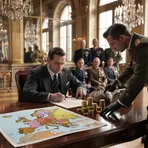
A 1919 peace treaty that ended World War I and made Germany give up land and pay money


- Specialized
A sale of property agreed directly between buyer and seller without an auction

- Archaic
A port in China, Korea, or Japan opened to foreign trade by treaty in the 1800s and early 1900s
How Binding
- Formal
509
4.1
 832
4.0
832
4.0
- Formal
148
3.4
- Specialized
114
4.1
- Formal
∞
1.4
Surface Forms
Morphology
Etymology
Treaty comes from the same root as treat, which originally meant 'to handle' or 'to deal with' in talks between people. So a treaty is a formal 'deal' where countries 'handle' their problems and agree on rules.