
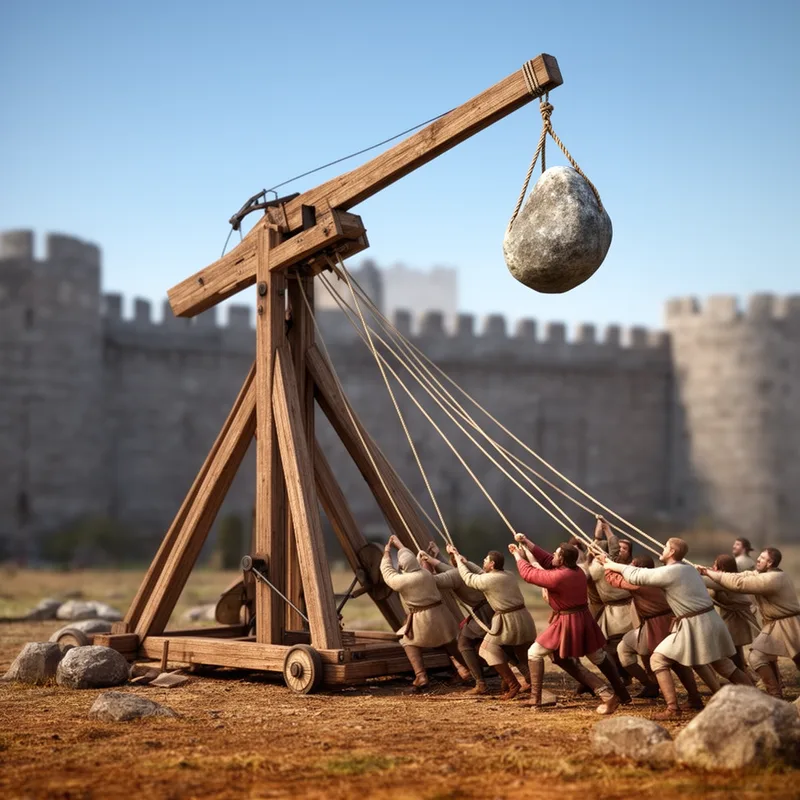
traction trebuchet
- noun
- /ˈtrækʃən ˈtrɛbʊˌʃɛt/
- Archaic
- The soldiers worked together to pull the cords of the traction trebuchet, successfully launching the heavy projectiles.
Examples
-
During the siege, the army used a traction trebuchet to breach the city walls.
-
The traction trebuchet launched the stone over the castle walls.
-
By coordinating their efforts, dozens of soldiers could operate the traction trebuchet efficiently.
-
The museum's display includes a replica of a medieval traction trebuchet.
-
During the siege, the army used a traction trebuchet to breach the defenses.
-
During the battle, the engineers set up a traction trebuchet to attack the enemy fortifications from a distance.
-
At the reenactment event, visitors watched as the traction trebuchet was operated by a team of volunteers.
Synonyms

 35
6.6
35
6.6

A device that launches objects forward with great force, like planes from a ship
 4
9.9
4
9.9
A large medieval machine that throws heavy stones at walls

A large medieval war machine like a catapult that threw heavy stones

A medieval machine worked by people that throws large stones with a long arm

A large medieval machine with a long arm that throws heavy stones

A large ancient Roman machine that threw heavy stones at walls
How Powerful


Surface Forms
Morphology
The compound follows a clear noun+noun composition where 'traction' (pulling force) modifies 'trebuchet' (a catapult), so the overall meaning — a trebuchet powered by pulling — is directly derivable from the parts. Even though 'traction' can be used in specialized medical contexts, its core sense of 'pulling' is accessible and the construction is transparently compositional for learners who know both words.
Etymology
Traction trebuchet is named for how it works: traction refers to people 'pulling' ropes and the trebuchet is the long arm and sling that 'throws' stones. So it means a kind of catapult powered by people pulling to launch stones.