

to the rhythm of
 8
3.2

- idiom
- My group swayed and clapped to the rhythm of the song.
- to the rhythm of the drums
- sway to the rhythm of
- dancing to the rhythm of
Loading YouTube…
Watch on YouTubeOr I could slash apart colored blocks to to the rhythm of the music.
- Or I could slash apart colored blocks to to the rhythm of the music.
- So by attending to the rhythm of the breath or breathing it in certain rhythms sets the clock in in its right perspective.
Examples
-
She tapped her foot to the rhythm of the upbeat song playing in the background.
-
But Noah drummed his fingers to the rhythm of the Grateful Dead.
Fiction book (1995) -
Tonight they would dance together to the rhythm of the drums.
Fiction book (1995) -
The girl danced to the rhythm of a popular song.
Fiction book (1998) -
Waves rushed in and out, crashing and sighing to the rhythm of the couple's movements.
Fiction book (1999) -
Loose seeds shake inside as they shuffle in the sandy dirt to the rhythm of the drummer.
Blog text (20) -
Happy tires make happy drivers, Phillip thought, drumming his fingers on the wheel to the rhythm of Keith Richards's outlaw guitar.
Fiction book (1998) -
The dancers moved gracefully to the rhythm of the music, perfectly synchronizing their steps.
-
As we walked, we spoke softly to each other to the rhythm of the gentle waves crashing on the shore.
Synonyms
 9
2.2
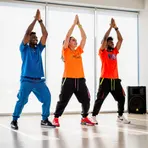
At the right beat so movement matches the music
 9
4.1
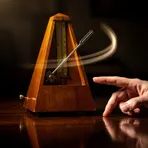
In a steady pattern of sound or movement
How Rhythmic

Surface Forms
Morphology
to + the + rhythm + of
The phrase 'to the rhythm of' is a compositional prepositional sequence: 'rhythm' denotes a regular beat or pattern and the prepositions 'to'/'of' express alignment, so the meaning 'in accordance with the beat/tempo' follows directly from the parts. This construction is cross-linguistically common (e.g. Spanish 'al ritmo de', French 'au rythme de'), making it predictable for a B1 learner who knows the constituent words.
Etymology
To the rhythm of comes from the picture of moving with a steady rhythm, like dancers or marching soldiers following a drum. That's why it means 'in time with the beat or pattern'.